- Bad Astronomy Newsletter
- Posts
- A Red Planet Holiday
A Red Planet Holiday
A mind-blowing image of Mars taken from above the planet itself

Philip Plait
December 25, 2025

The Trifid Nebula and environs. Credit: RubinObs/NOIRLab/SLAC/NSF/DOE/AURA
December 25, 2025 Issue #976
Still a few hours left to get the 20% discount!
At noon today (Dec. 25, 2025) the subscription sale ends, so if you’re looking for a significantly last-minute gift for someone or just want to upgrade from a free to premium subscriber, click here to get more info!
Marsy Christmas
An incredible shot of the Red Planet and Gray Moon
Santa Claus Conquers the Martians notwithstanding, the Red Planet is not generally associated with this time of year. After all, Mars was the god of war, and its two moons are named Phobos and Deimos — the gods of fear and dread — so that doesn’t really match the mood of the season.
But that doesn’t mean we can’t see a phenomenal image of Mars and Phobos together. Seriously, this is amazing:

Holy Ares! Credit: ESA/DLR/FUBerlin/AndreaLuck CC BY 4.0
WHOA. There’s a 24,000 x 12,000 pixel version, too.
This image was taken in June 2025 by the European Space Agency’s Mars Express orbiter, which has been in operation since it entered Mars orbit in December 2003. Yes, 2003. It has investigated the planet’s surface, atmosphere, and moons, providing tremendous discoveries over the decades.
The spacecraft is on a quite eccentric orbit, meaning it’s highly elliptical. At its lowest point it’s just 300 kilometers above the planet’s surface, but at its highest it’s over 10,000 km distant. So it sometimes can take very high-resolution images of Mars, and other times gets more of an overview.
Phobos orbits about 6,000 km above the planet’s surface, which means Mars Express sometimes sees it below, against the disk of the planet itself. That’s what this image shows, with the potato-shaped moon (it’s about 26 x 22 x 18 km in size) in front of Mars. The brightness contrast is amazing. Phobos is actually one of the darkest large-ish bodies in the solar system, reflecting only 7% of the light that hits it. Mars reflects about 17%, while Earth (with its white clouds and ice) reflects more like 40%.
I’ll note the orbit of Phobos is so low that it can only be seen from the equatorial regions of the planet; from higher latitudes it’s always below the horizon. It also orbits so rapidly that it actually takes less than a Martian day to complete one circuit; that means it rises in the west and sets in the east! Weird.
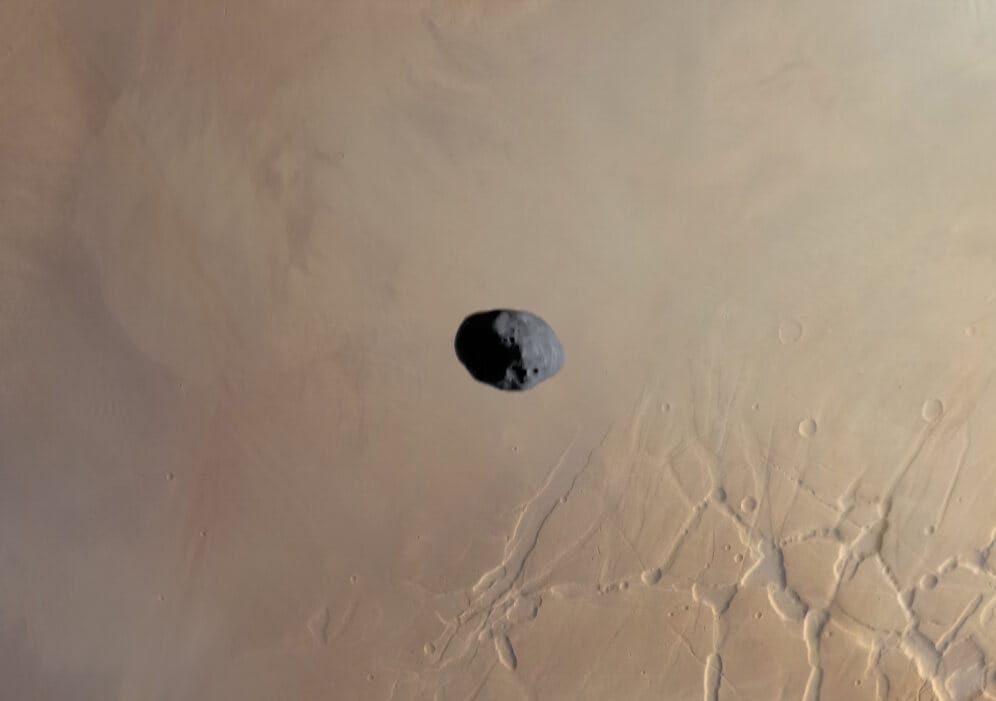
A close-up of Phobos cropped from the 6,000 x 3,300 pixel version of the image; note this is still not the highest resolution available! Yegads. Credit: ESA/DLR/FUBerlin/AndreaLuck CC BY 4.0
The image was created by Andrea Luck, who is an accomplished image processor. It’s a composite of three images taken in different filters. What’s displayed as red is actually from a neutral-density filter, one that only dims light but doesn’t select for a specific color. Blue and green are from blue and green filters.

Subscribe to Premium to read the rest.
Become a paying subscriber of Premium to get access to this post and other subscriber-only content.
Already a paying subscriber? Sign In.
A subscription gets you:
- • Three (3!) issues per week, not just one
- • Full access to the BAN archives
- • Leave comment on articles (ask questions, talk to other subscribers, etc.)
Reply