- Bad Astronomy Newsletter
- Posts
- A spider web a million trillion kilometers wide: JWST’s view of IC 5332 (1)
A spider web a million trillion kilometers wide: JWST’s view of IC 5332 (1)
Also: How many near-Earth asteroids have been visited by spacecraft?

Philip Plait
February 10, 2026

The Trifid Nebula and environs. Credit: RubinObs/NOIRLab/SLAC/NSF/DOE/AURA
February 10, 2026 Issue #996
Free audiobook offer: The Universe Abridged Beyond the Point of Usefulness
Wanna hear me narrate a really funny book?
[Quick note first: I meant to send this to free subscribers this morning, but by mistake only sent it to Premium subbies, so please forgive this late issue; but given the offer below and the time limit on it I wanted all y’all to see it. Thanks! -TBA]
As some of you may know, my friend Zach Weinersmith creates, among many other things, the Saturday Morning Breakfast Cereal webcomic. He’s also an author, having written many books, including one with me (which you can still get if you care to).
He also has a series of books where he covers a vast topic and condenses it down so much it’s not terribly helpful. These books are short and very funny… and that includes one titled The Universe Abridged Beyond the Point of Usefulness. It’s available in print, but even better: I narrated the audiobook version!
This makes it even funnier, in my opinion.
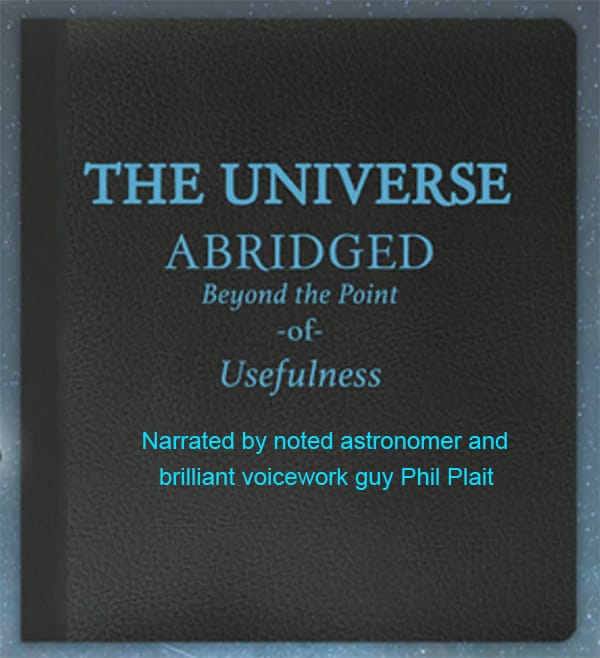
The book, with a completely unaltered title in any way I swear. Credit: Zach Weinersmith (and not in any way Phil Plait)
And now, because we love you, Zach has made a coupon code to get the audiobook half off! Click here to get the discounted audiobook. Make sure you click the audiobook button under “Format”, add it to the cart, and when you go to check out add the coupon code UNIVERSEAUDIO-PHIL-SOCIAL in the “discount code” field. Then the price should be $2.50. Please, one per subbie! Thanks.
This offer expires on February 19 at 11:59 p.m. Eastern US time, which I have been reliably informed is Nicolaus Copernicus’s birthday, so if you’re looking for a last minute gift you’re all set.
I had a lot of fun narrating the book, and I hope you enjoy it.
P.S. This is the second book I’ve narrated, the first of which being my own Under Alien Skies (go to the “Buy Now” button at the top right of that page to get a list of where you can get it). I’d love to do this more; if you happen to know of a science book that needs a narrator, you know where to find me.
Near-Earth Asteroids visited by spacecraft
We’ve seen a few up close now
The February issue of the ESA’s Near-Earth Object Coordination Centre’s newsletter has an interesting list in it: the Near-Earth Asteroids (or NEAs) that have been visited by spacecraft:

Teeny close-by worlds visited by spacecraft. Credit: ESA/NEOCC
Eros was the first, and this is the 25th anniversary week of that event. I remember it; waiting excitedly for the first images to be sent out to the public. It took a while, 2001 was before the internet was in full swing.
The table lists the object, the spacecraft, the date, the closest approach (usually 0, meaning it landed), and the equivalent diameter, which is the volume of the asteroid if it were a sphere. Eros, for example, is a bent potato about 34 x 11 x 11 km in size, so you can calculate the volume of it and then work backwards to get the size of a sphere the same volume. Given how irregular asteroid shapes can be, it’s a convenient way to compare them on equal footing.
You may recognize other rocks on that list, like Didymos and Dimorphos, the binary asteroid NASA slammed the DART mission into.
Mind you, this is only NEAs, not all asteroids and comets we’ve seen up close. NEAs are defined as asteroids that get within 200 million kilometers of the Sun (1.3 times the Earth-Sun distance). If they’re bigger than 140 meters in diameter and get within 7.5 million km of Earth’s orbit they get classified as Potentially Hazardous Asteroids.
So for example the asteroids (really protoplanets) Vesta and Ceres aren’t on the list despite being targets of the Dawn mission because they’re in the Main Asteroid Belt, and never get close enough to the Sun. The comet 67P/Churyumov-Gerasimenko, visited by the ESA’s Rosetta spacecraft, is not on the list because it’s not an asteroid. I think you get the picture.
This list will get bigger, of course, as we venture out to study these rocks. They’re the leftover rubble of the formation of the solar system, modified over the eons by collisions, sunlight, and cosmic rays. They have a lot to tell us about our history, and our potential future.
So happy anniversary to the NEAR-Shoemaker team for being the first! May there be many, many more.
JWST images show the structure of dust in this face-on spiral galaxy
Since I’ve moved back to Virginia — having lived in the state before for a total of about 25 years — I’ve been reminded of just how happy spiders are here. For the eight or so warm months in the year, the moment I go outside I grab a big stick and wave it frantically in front of me as I walk, lest I have my head entirely enveloped in silky strands and remembered horror movies from childhood.
So it’s with some trepidation I present to this image of IC 5332:

IC 5332, as seen by JWSR. Credit: ESA/Webb, NASA & CSA, J. Lee and the PHANGS-JWST and PHANGS-HST Teams
It’s hard not to get all arachnidy seeing this, but it’s a bit bigger than any terrestrial spider can spin: IC 5332 is a face-on spiral galaxy about 33 million light-years away.
The image was taken by JWST using its MIRI camera (for Mid-Infrared Instrument), which can see wavelengths of light much longer than the ones our eyes see. This is where, for example, cosmic dust glows, and that’s predominantly what you see here.
“Dust” is a generic term for small grains of silicate (rocky) and carbonaceous (think of it as sooty, since it really is) material produced by stars. It’s mostly made in red supergiants, massive stars like Betelgeuse as they prep themselves to go supernova. The explosion itself generates a lot of dust as well. This material blows away into space, and gets swept up by the galaxy’s rotation into long filaments made up of lots of individual clouds. What you wind up with is a spiral with what looks like interconnecting strands of dust clouds.
Images like this help astronomers trace the spiral arms, get info on the dust (like temperature and density), and find the properties of clusters of stars. Massive stars don’t live long before they turn into red supergiants, and don’t get far from their birthplace; tracing the location of the dust tells us where those stellar nurseries are; in fact that’s why this image was taken as part of a larger survey of nearby galaxies by a group called PHANGS, for Physics at High ANgular resolution in Nearby GalaxieS.

Subscribe to Premium to read the rest.
Become a paying subscriber of Premium to get access to this post and other subscriber-only content.
Already a paying subscriber? Sign In.
A subscription gets you:
- • Three (3!) issues per week, not just one
- • Full access to the BAN archives
- • Leave comment on articles (ask questions, talk to other subscribers, etc.)
Reply