- Bad Astronomy Newsletter
- Posts
- An egg-shaped planet orbits a death star
An egg-shaped planet orbits a death star
And that’s not the only thing weird about it

Philip Plait
February 23, 2026

The Trifid Nebula and environs. Credit: RubinObs/NOIRLab/SLAC/NSF/DOE/AURA
February 23, 2026 Issue #1001
Can you see dinosaurs from another galaxy?
You Q’ed, I A’ed
Quick note: I got a question from a reader asking a really fun question: If aliens in a galaxy 66 million light-years away from us wanted to see dinosaurs walking the Earth, how big a telescope would they need?
The answer is a lot, lot bigger than I expected, so I did the math for Scientific American.
And don’t forget I have a column, “The Universe”, for SciAm that goes up every Friday!
An exoplanet that has a weird shape and composition and oh yeah orbits a pulsar
Pulsar planets are weird in the first place but this one goes the extra 1.6 km
Now that we know of at least 6,000 exoplanets — alien worlds outside our solar system — it can be lost to memory that the first ones ever confirmed orbited a pulsar.
That’s not where you’d expect to find planets! A pulsar is a neutron star, the leftover core of a star that went supernova; the core collapses down and, if it has less than about 3 times the mass of the Sun, it gets squeezed to the ridiculous diameter of only about 25 kilometers. This gives them incredible density, gravity, and magnetic field strength. As they rotate, twin beams of energy shoot out from the poles can sweep over Earth, creating a pulsing lighthouse effect.
So, planets there would be sitting in highly extreme conditions, getting blasted with gamma and X-rays, pulled by the phenomenal gravity, and more. Yet, quite a few such pulsar planets are found. They’re not exactly common, but enough exist to show that the means to make them aren’t all that rare.
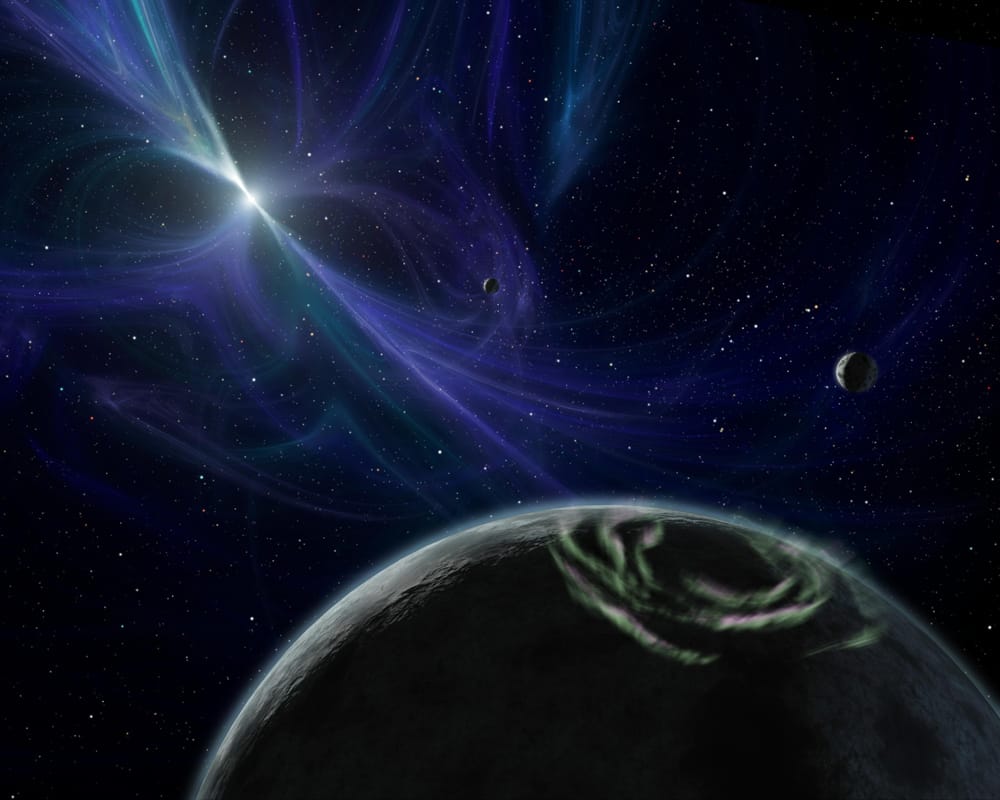
Artwork depicting the first pulsar planets found, around the pulsar PSR B1257+12. Credit: NASA/JPL-Caltech
PSR J2322-2650b is just such a planet (note the “b” indicating it’s a planet orbiting the pulsar PSR J2322-2650). The pulsar is about 750 light-years from Earth, and is an odd one. It’s a millisecond pulsar, meaning it rotates extremely rapidly, about 300 times per second — yes, per second — about as fast as the blades of a kitchen blender. Mind you, this is an object with the mass of the Sun and the size of a city rotating this quickly! It’s not a very luminous one, though, giving off about a tenth the energy the Sun does, making it faint for such a beast. That may be because it has a relatively weak magnetic field, only (“only”) about 20 million times stronger than Earth’s.
The planet orbits the pulsar at a distance of about 1.5 million kilometers — 1% of Earth’s distance from the Sun — and takes just under 8 hours to circle the pulsar once. That close in the gravity from the pulsar is fierce, and in fact the tides from the dead star pull the planet into an elongated egg shape (the Moon does something similar to Earth, though with much smaller effect, but still enough to create the daily tides). So right away the planet is odd.
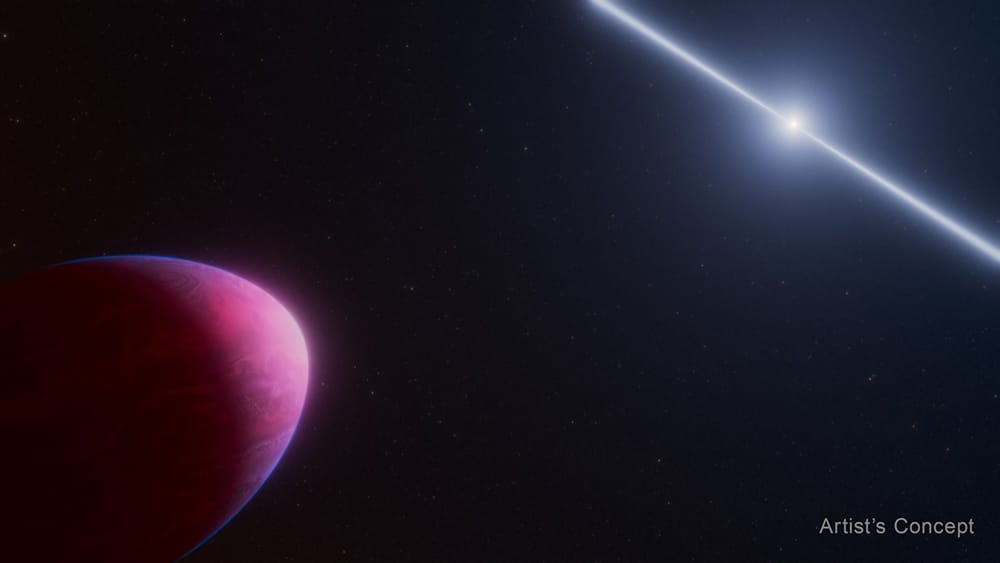
Artwork of a gas giant planet pulled into an egg-shape by the tides from a nearby pulsar, seen blasting out twin beams of energy. Credit: NASA, ESA, CSA, Ralf Crawford (STScI)
The planet’s unusual in other ways, too. It has a mass of only about 0.8 times Jupiter’s, making it very lightweight for a pulsar companion. It’s tidally locked to the pulsar, meaning it spins once for every time it orbits, so it always shows the same face to the star (like the Moon does to Earth). That day side gets very hot, probably around 2,000°C, while the night side is cooler at around 650°C (though those temperatures are from modeling its behavior and not directly measured).
This means it’s hot enough to glow in infrared. At the same time, the pulsar itself is so faint in infrared that it’s essentially invisible to a telescope, making the planet the perfect target for JWST, the grand infrared space telescope. Astronomers observed it over an entire orbit, plus a few more observations to get spectra [link to journal paper]. Without the star’s light overwhelming the planet’s they were able to get some interesting data.
What they found is peculiar indeed: the atmosphere of the planet is very rich in molecular carbon: C3 and C2. This has never been seen in any exoplanets before, nor in our own solar system planets. At the high temperatures of the pulsar planet carbon will usually bind with other atoms like oxygen and nitrogen, but that doesn’t seem to be happening here. That implies those other elements are scarce in the planet’s atmosphere, which again is weird.
Why should that be? One explanation is in the fact that PSR J2322-2650 isn’t just a millisecond pulsar, it’s a black widow pulsar. These are pulsars orbited by a companion object, sometimes a star or brown dwarf but sometimes a white dwarf: the dead core of a star that was once like the Sun. The pulsar’s intense gravity can strip material off the companion which then falls onto the pulsar. The material gets extremely hot when it does so, and this heat can then blast the companion and strip it of its surface material — hence the name black widow, since the pulsar eats and kills its companion.
If the pulsar planet PSR J2322-2650b was once an actual star that would explain things. The star could have been massive enough to fuse helium into carbon, like the Sun eventually will in a few billion years. If so, and was stripped at just the right rate, that could leave behind a very low-mass planet-like object.
I’m not entirely comfortable with that explanation though, since you have to get the timing just right. The astronomers posit the planet may have once been a dense white dwarf that was stripped by the pulsar. That would also explain the oddities, but again the timing has to be just right or else the planet would be completely stripped away by now. They also speculate the planet could have once been the core of a stripped star where the carbon and oxygen crystallized as the star cooled; the carbon would float to the top which is why that’s what we mostly see. It’s still not clear how oxygen and nitrogen would stay completely out of the atmosphere, though. In the end, how this planet formed and why its air looks the way it does now is a mystery.
So, no matter what, we’ve got a weird one here. The good news is that this is a fantastic target for advanced telescopes like JWST, so I expect it will continue to be a favorite target for pulsar planet aficionados. I’d love to know more about this object! Exoplanets are all pretty strange compared to our own system, but hoo boy, some are more strange than others.
Et alia
You can email me at [email protected] (though replies can take a while), and all my social media outlets are gathered together at about.me. Also, if you don’t already, please subscribe to this newsletter! And feel free to tell a friend or nine, too. Thanks!
Reply