- Bad Astronomy Newsletter
- Posts
- Diet Hard
Diet Hard
A physics-based approach to nutrition is at best only mildly helpful

Philip Plait
December 29, 2025

The Trifid Nebula and environs. Credit: RubinObs/NOIRLab/SLAC/NSF/DOE/AURA
December 29, 2025 Issue #977
The Thermodynamic Diet
It’s physically correct though metabolically not so great
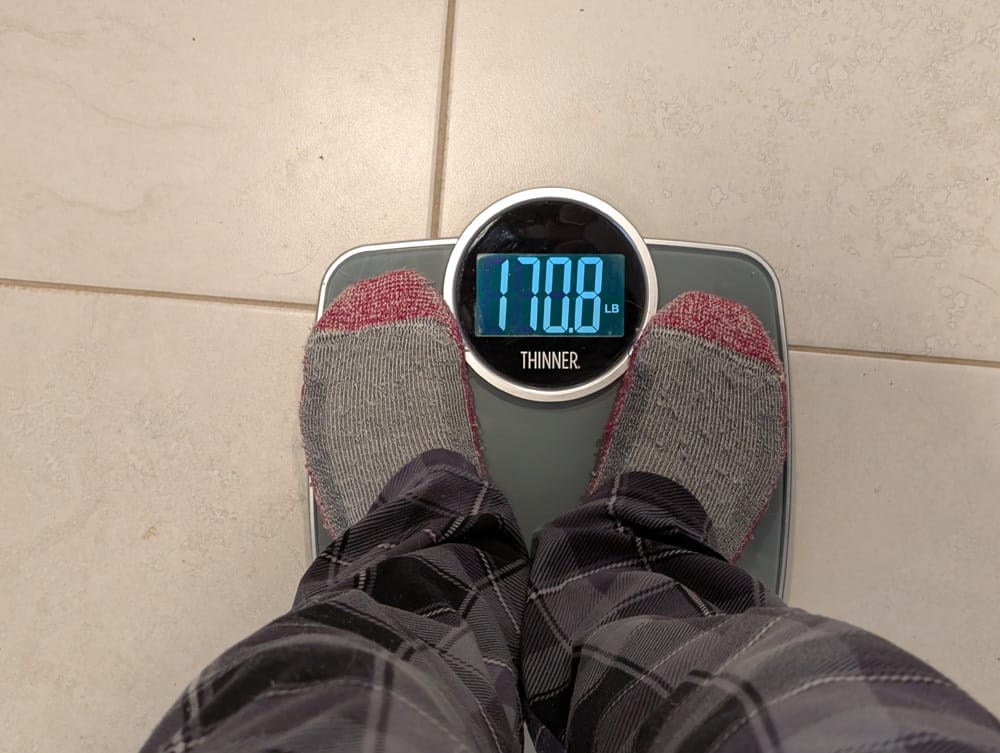
Uh oh. But let’s see, my phone weighs 9 ounces and my hoodie is at least a pound and I just ate lunch and, as per my article below, a wedge from a large Toblerone. So, yeah, this tracks. Credit: Phil Plait
Oh, the days after the December holidays, when many of us start to regret the amount of food we ate the previous week. I get it; it’s the family tradition to get me chocolate for Christmas — specifically a 340-gram Toblerone bar — which I love, but which doesn’t love me.
I also know a lot of folks turn to diets to make up for the overindulgence, which is fine, though studies show they don’t always work long-term. Worse, though, people hear about fad diets and try them. Many are nutritionally bereft, and quite a few make no sense at all. They might help you lose some weight for a short time, but not for long, and can even do great harm.
Out of curiosity I’ve investigated many diets, and when they come from actual doctors or (evidence-based) nutritionists, they generally boil down to three things: eat stuff that’s good for you, eat fewer calories than you burn, and get exercise.
Some years ago I had a funny idea for a short book that I called The Thermodynamic Diet. I’d get a real nutritionist to partner with, and give actual good dieting advice but shroud it in New Age gobbledygook. It would be a best seller and actually be helpful! I never got around to pursuing the thought for a few reasons, one of which is that it felt slightly icky to appropriate nonsense even in the cause for good, and also I didn’t want to be responsible for people who misread the book and wound up screwing up their health. I prefer not to get sued by chuckleheads.
One idea from that stalled project still bumps around in my head, though, and it’s physics based, so I figure why not tell you about it?
Your body is similar to an engine. It needs fuel to run, and burns that fuel to create energy needed to work; literally, since “burning” is just taking apart chemicals (sometimes by adding oxygen) and releasing the energy stored in the molecular bonds. When you eat food the body uses the energy released to do things like move your muscles, make your organs do whatever it is they do, allow you to consider making decisions you’ll later regret, and so on.
One of these functions is maintaining your body temperature. Typical room temperature is roughly 20°C while your body is at 37°. It takes quite a bit of energy to keep your body warmer than the surrounding air. So, just existing means you burn energy.
And that gave me an idea…
What we usually think of as a calorie is a unit of energy. But it’s a confusing one because it’s actually a food calorie; the original definition of a calorie is a much smaller unit, and a food calorie is actually 1,000 of those (or a kilocalorie). From here on out I’ll use the term in the sense of a food calorie, since this is what American foods use to talk about energy you get from that food. In other countries, they far more sensibly use Joules, the metric unit of energy. One calorie is equal to about 4,184 Joules, so you can convert the math below if you’re not from the US.
This is where things get interesting.
If you want to heat water, say, you have to add energy to it (in a sense that’s what temperature is: stored energy), and you can measure that energy using calories. As a specific example, a calorie is the energy needed to raise one liter of water by one degree Celsius.
When you drink water, your body heat raises its temperature until they’re equal. But that takes energy! So, literally, you’re burning calories even when you drink water. What a way to lose weight!
Or is it? A typical glass of water is roughly a half a liter, so it takes 0.5 calories to raise it one degree. If the water is cold, say 2°C (the recommended temperature to set your refrigerator), then getting it to 37° will take 35° x 0.5 calories per degree = 17.5 calories.
That’s not much. A single triangular wedge of my Toblerone is about 160 calories. I’d have to drink 9 glasses of cold water to offset that. Oof.
That’s disappointing. I was hoping it would be a better trade. I mean, think of it: ice cream is even colder, so you use up some of the calories in it just by eating it! But physics, too, is cold, and the emotionless equations don’t lie: you only use a fraction of the energy released in ice cream to heat it.
Bummer. Like I said earlier, the best way to lose weight is to eat less than the energy you burn. That’s just straight up thermodynamics. Available energy is a finite resource, so if you use more energy than you take in, that extra has to come from somewhere. That can be in the form of fat, for example, which has complex carbon-based molecules that store a lot of energy. Burning it releases energy the body can use.
Getting exercise on top of that is even better (assuming you’re able to), since it expends even more energy. As an example, walking 15 minutes at a leisurely pace burns about 60 calories for me, so a half hour at a slightly brisker pace compensates for that silky, lovely chocolate wedge* .
Of course, biology is way more complicated than just thermodynamics — which itself ain’t exactly simple — so I’m hugely oversimplifying here. Don’t take any of this as advice! I’m just spitballing the physics. If you really do need to lose weight or get exercise or anything like that, go talk to your board-certified doctor (and for heaven’s sake don’t listen to anti-science crackpots like RFK Jr.).
So what can we conclude? Drinking cold water won’t help you substantively lose weight, unless you drink so much you’re likely to have other quite unfortunate issues. Exercise is good, if you can. Also, physics is fun, if sometimes a letdown.
And, of course: enjoy the holidays however you do so.
* Well, kinda. That’s not a great mindset to have — exercise should be for its own benefit, and not as some sort of penance for eating something yummy (plus it has many other positive aspects, obviously). Also, there are other things in chocolate besides calories that your body doesn’t really need. I don’t think I need to belabor this point further, though I’ll note that having the occasional treat isn’t so bad, and is good for your mental health. Still, you should probably eat more vegetables. Have you ever had kohlrabi? It’s delicious!
Et alia
You can email me at [email protected] (though replies can take a while), and all my social media outlets are gathered together at about.me. Also, if you don’t already, please subscribe to this newsletter! And feel free to tell a friend or nine, too. Thanks!
Reply