- Bad Astronomy Newsletter
- Posts
- How big are the liquid methane waves on Titan? And another Voyager 1 instrument turned off
How big are the liquid methane waves on Titan? And another Voyager 1 instrument turned off
Very cool research shows just how gnarly surfing is on other worlds, and a venerable spacecraft is losing power rapidly

Philip Plait
April 23, 2026

The Trifid Nebula and environs. Credit: RubinObs/NOIRLab/SLAC/NSF/DOE/AURA
April 23, 2026 Issue #1027
The final hours of the subscription sale
Deep discount extended to 4:00 p.m. Eastern US time
Reminder: If you want to upgrade from being a free subscriber to premium, the nearly 50% off sale to $3.20/month (for the first month) or $32/year (for the first year) ends TODAY at 4:00 p.m. Eastern US time (I had originally said noon, but then realized that’s not much time after this issues goes out for folks to jump in).
Sign up here! After the sale ends the prices go back up to $6/month and $60/year, so get the cheaper price while you can! And, as always: THANKS!
Another Voyager 1 science instrument has been turned off
A necessary step to keep the spacecraft alive
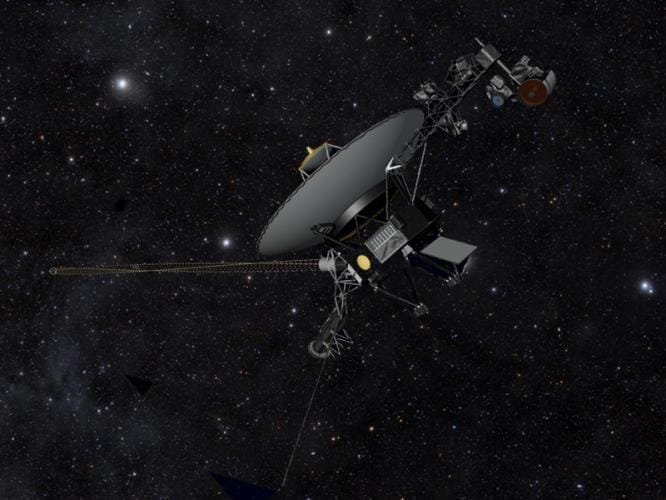
Drawing of Voyager. Credit: NASA/JPL-Caltech
Well, this kinda sucks, but it’s no surprise: another scientific instrument onboard the Voyager 1 spacecraft has been turned off.
On April 17, 2026, engineers switched off the spacecraft’s Low-energy Charged Particle Detector, a device that measures the energy, direction, and composition of subatomic particles zipping through space.
It was shut off because the device powering the spacecraft, a radioisotope thermoelectric generator, is losing power all the time, and can no longer keep all the subsystems on the spacecraft operating. As I wrote in BAN #856 on March 2025, other instruments have been turned off over time for the same reason.
Losing the detector means an extra year of power overall for Voyager 1, which is the trade made. It still has other instruments working, which is really important: it’s over 25 billion kilometers from Earth, measuring an environment that is essentially interstellar space. That’s not something we can easily do, and doing so in situ is up to basically just Voyager 1 and its twin Voyager 2.
More events are planned, including shutting down a lot of instruments all at once to use lower power consumption devices instead. Tests for that are planned in May and June, and if that works it will be fully implemented as early as July. Stay tuned.
Wind surfing on Titan — now you can plan ahead for your Saturnian vacation
Scientists calculate wave heights on alien worlds
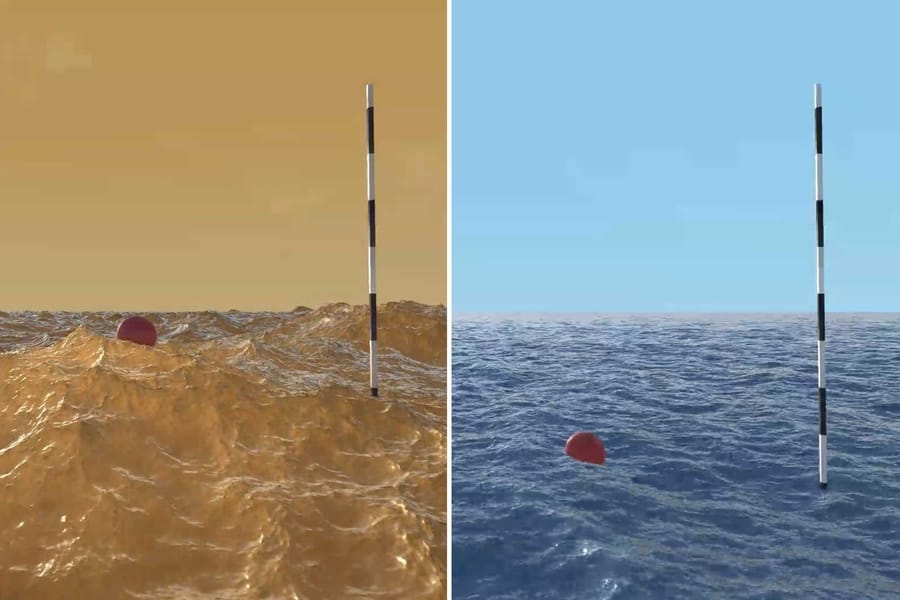
Waves on Titan (left) are much higher than they are on Earth (right) at the same wind speed. The floating red ball is one meter wide, and the marks on the sticks show one-meter heights. Credit: Schneck et al. 2026
If you’ve ever stood on a beach looking over the ocean (or a big lake; I remember days on Lake Michigan like this), you can see waves rolling in toward land. These waves are wind-generated; as the wind blows over the surface of the ocean the water moves with it, piling up a bit. The energy from the wind is transferred to the liquid, moving through the water horizontally, and the water moves up and down in response. It’s actually a fairly complicated physical effect, even though it seems familiar.
The equations behind it are fierce, and involve many parameters like the liquid density and viscosity (how easily the liquid flows), the wind density and speed, and more. Even (especially!) the gravity.
These conditions are different on different worlds, so the waves we’d see on them would be different, too.
A team of scientists were curious about this, so they created a physics-based computer model that crunches the numbers to determine how waves grow on alien worlds [link to journal paper].
First, as a sanity check, they used it to model waves on Earth, and got numbers that corresponded to real-world measurements. So that’s cool.
Then they tried it for other places. Titan is the largest moon of Saturn, and is the only other large body in the solar system we know of with liquid on its surface. However, that liquid is actually methane, not water! Titan is extremely cold (about -180°C), so methane is a liquid there. Titan has an atmosphere of nitrogen that’s actually denser than our own air, despite the lower gravity (about 1/7th Earth’s).
That makes thing different indeed. Not only that but liquid methane is much less dense than water (somewhat less than half, if I’m reading that page correctly) and also much less viscous, so waves there should be quite different than here.
That’s what the scientists found: waves begin to grow at lower wind speed and grow to higher amplitude than they do on Earth. That’s what I’d expect given the conditions, but it’s nifty to see the physics back it up. For example, on Earth a wind speed of 10 meters per second — 22 miles per hour, which is pretty brisk — creates waves two to three meters high with max heights around 5 meters. On Titan that same wind speed creates wave 15 meters high that peak at 40 meters. That’s higher than even rogue waves on Earth!
They found this to be the case at all wind speeds; at a few meters per second on Earth the wind barely gets the water to move at all, but on Titan that same speed generates waves several meters high!
Titan may be a better place to surf than Santa Cruz. You’ll freeze to death, maybe even before you suffocate, but still.
One thing though: the waves move more slowly. That might be good for beginners. You can see that for yourself in a video the scientists made, showing waves on Earth (right) versus Titan (left) at the same wind speed:
Cooooool.

Subscribe to Premium to read the rest.
Become a paying subscriber of Premium to get access to this post and other subscriber-only content.
Already a paying subscriber? Sign In.
A subscription gets you:
- • Three (3!) issues per week, not just one
- • Full access to the BAN archives
- • Leave comment on articles (ask questions, talk to other subscribers, etc.)
Reply