- Bad Astronomy Newsletter
- Posts
- Looks like the asteroid 2024 YR4 won’t impact the moon, plus Rubin Observatory sends out its first cosmic alerts... 800,000 of them!
Looks like the asteroid 2024 YR4 won’t impact the moon, plus Rubin Observatory sends out its first cosmic alerts... 800,000 of them!
Supernovae, asteroids, and more: That’s a lot of alerts.

Philip Plait
March 09, 2026
In partnership with


The Trifid Nebula and environs. Credit: RubinObs/NOIRLab/SLAC/NSF/DOE/AURA
March 9, 2026 Issue #1007
The moon has dodged a space bullet
Asteroid 2024 YR4 will miss the moon
The asteroid 2024 YR4 is a 60-ish meter diameter rock discovered in late 2024. For a while, there was a small chance it would hit Earth, but as observations went on and its orbit nailed down, the odds got longer and longer until an impact was ruled out.
… for us, at least. There was still a 4% chance it would hit the moon in 2032. That’s exciting! An impact like that would present little danger to us on Earth (maybe a meteor shower sometime later as bit of ejected lunar material made its way down to our planet) but that’s it. And think of the science we could get!
But alas, that’s not to be: new observations using JWST have ruled out a moonish impact.
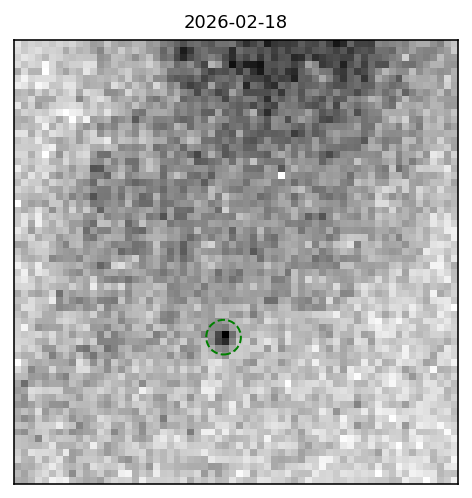
JWST’s view of the asteroid 2024 YR4 Credit: NASA, ESA, CSA, STScI, M. Micheli (ESA NEOCC)
The observation was taken on February 18, 2026, and shows the asteroid as a fairly faint blob. That’s not surprising, given how small the asteroid is and that it was around 500 million kilometers away when the observations were made.
But JWST is good at this. First, it has a huge 6.5-meter mirror, and second, it sees infrared light. Asteroids are warmed by the sun and glow in infrared, making it bright enough for JWST to see it. Another advantage is that how brightly it glows depends mostly on its distance from the sun and its size, so observations like this make it easier to determine how big it is. In visible light, we have to assume how reflective it is (called its albedo) to get the size, and that number is hard to know. So infrared observations are really helpful.
What do these names have in common?

Arnold Schwarzenegger
Codie Sanchez
Scott Galloway
Colin & Samir
Shaan Puri
Jay Shetty
They all run their businesses on beehiiv. Newsletters, websites, digital products, and more. beehiiv is the only platform you need to take your content business to the next level.
🚨Limited time offer: Get 30% off your first 3 months on beehiiv. Just use code PLATFORM30 at checkout.
Also, the keen vision of JWST means the astronomers who took the shot could determine its precise location in the sky. This is critical for orbital determination. I’ve described this approximately eighty bazillion times, but the basic idea is that any error in a position measurement means the orbit is harder to determine, and it gets worse the farther into the future you try to predict it. That’s why there was still a calculated chance YR4 could hit the moon.
But the new observations now rule that out. It’ll still give the moon a close shave in 2032, by something more than 20,000 kilometers. That’s close, but not close enough to hit.
I have to admit I’m a little sad about it. Impacts are amazing events — I remember the Shoemaker-Levy 9 impacts on Jupiter well — and having one this close would have been a great opportunity without any real risk to us.
The good (?) news is there are plenty more small rocks out there. Some hit the moon, some hit us. The actual good news is that we are getting better at spotting them way in advance, and, given enough time and effort, we can actually do something about one if it looks dangerous.
Vera Rubin Observatory sent out some alerts for changes in the night sky
…and it’s a lot. A lot.
Remember when I first wrote about the Vera C. Rubin Observatory, which will scan a vast section of the night sky every night and look for things that change? Asteroids moving, supernovae exploding, variable stars, um, varying? And how this would be a huge revolution in how we see how things in the cosmos change?
Yeah. Using the first observations from its commissioning phase, automated software checked the images for changing objects — what astronomers call transients — and generates alerts for each one it finds.
On February 24th , the folks on the Rubin team released the first passel of alerts.
800,000 of them.
HOLY MOLY. That’s a lot of objects. But then, it uses a 3.2 GIGApixel camera that takes images every 40 seconds, so yeah, it’ll find a lot of stuff.
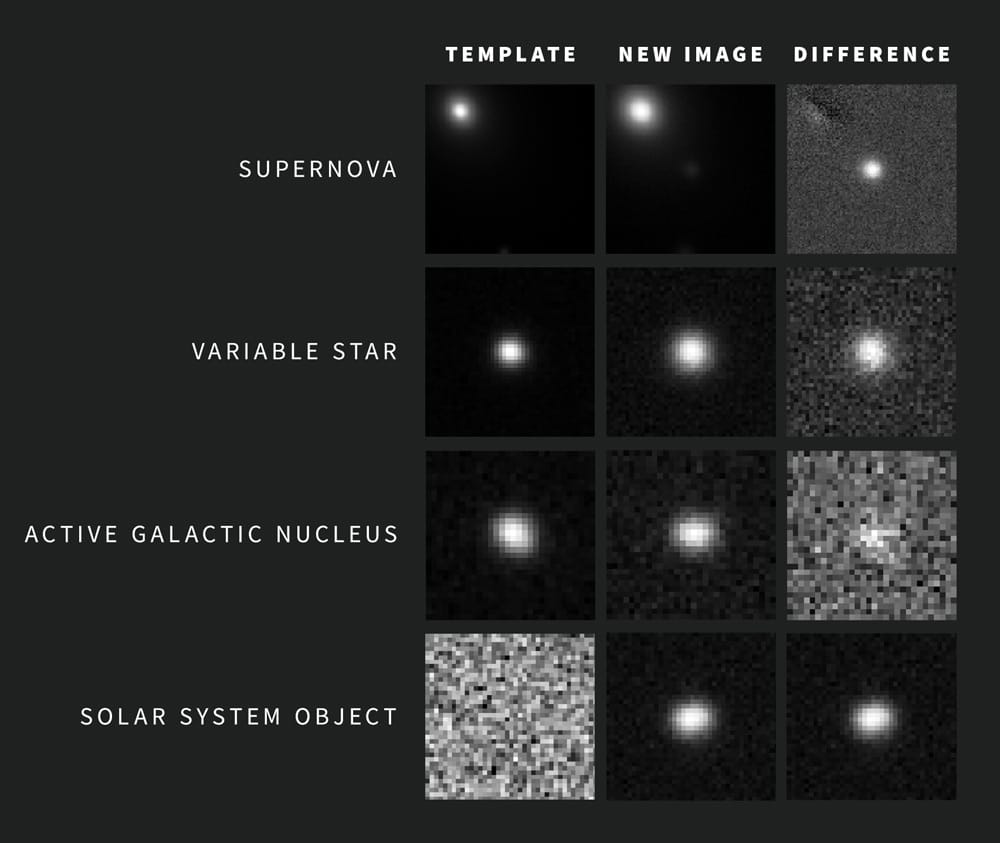
Four examples of transients found in the images. See text for description. Credit: NSF–DOE Vera C. Rubin Observatory/NOIRLab/SLAC/AURA
The way it finds transients is simple in principle. An observation of a part of the sky is used as a template. A new image is taken, and then subtracted from the first (data are just numbers, where a brighter object generates a bigger number in those pixels). If there is a significant amount of new light, then the software flags it as a potential transient.
The image above shows that. The first column is the template, made from clean observations. The second column is the new image, and the third is the difference between them. The changes stand out.
In practice of course it’s a lot more complicated! Earth’s atmosphere is always in motion, blurring things out and changing the brightness of stars. Random noise in fainter objects can make the shape appear to change. A little bit of cirrus cloud can make things appear fainter. On and on. All those need to be accounted for, which is a pain, but possible statistically.
And that’s the point of the survey. There are a lot of objects that can change shape, position, or brightness, and the idea is to find as many of them as possible and alert astronomers quickly so they can follow up. The faster we respond, the more we can learn about the engines behind the changes.
And 800,000 is a lot of transients… but astronomers predict Rubin will see as many as seven million per night.
Obviously, no human can keep up with that, so there is a bit of software, called a broker, that stands in between the detections and the alerts. These use neural nets — software that can learn to recognize various types of objects after being trained on known data — to sort and classify the alerts. That way someone can sign up to hear only about possible supernovae, say.
It’s hard to predict how this will be used; in many cases it will be like I said, triggering follow-up observations. But this amount of generalized data can be analyzed in a lot of ways, including getting statistics (how many galaxy nuclei have supermassive black holes that flare, by how much, at what distances, and so on). That will lead to other uses as well. Whenever we build a general use system in astronomy clever people find clever ways to use it. I am very much looking forward to the actual survey getting started later in 2026!
Et alia
You can email me at [email protected] (though replies can take a while), and all my social media outlets are gathered together at about.me. Also, if you don’t already, please subscribe to this newsletter! And feel free to tell a friend or nine, too. Thanks!
Reply