- Bad Astronomy Newsletter
- Posts
- Mystery solved? Baffling huge nebula near Andromeda Galaxy is actually in our neighborhood
Mystery solved? Baffling huge nebula near Andromeda Galaxy is actually in our neighborhood
Weird arcing cloud of oxygen is most likely part of the Milky Way, not our giant neighbor

Philip Plait
December 15, 2025
In partnership with


The Trifid Nebula and environs. Credit: RubinObs/NOIRLab/SLAC/NSF/DOE/AURA
December 15, 2025 Issue #971
20% subscription sale extended
I decided to extend the 20% off subscription sale for this newsletter another week; there’s been a lot of interest, plus I had one subscriber ask if there was a way they could sign up for it the night before Christmas so it would be a surprise gift for a loved one, and I thought that was cool. Plus, I think a subscription makes for a good last-minute gift, so why not extend it to that last minute?
The sale now runs through noon (Eastern US time) on December 25th ! The discount means you can get a one-month subscription for $4.80 or a year for $48 (each runs for one term, so the sale price lasts for one month or one year, respectively). If you’re a free subscriber now’s the time to upgrade. And if you’re already a Premium subbie, first, thanks! And second, yeah, you can give the gift of the Universe to someone else.
Please and thank you!
The huge nebula near Andromeda is actually local to us
New observations of a strange gas cloud show it’s inside our galaxy, not external to it
In January 2023 I got an email that shocked me: Marcel Drechsler, an amateur astronomer, let me know that he and two others (Xavier Strottner and Yann Sainty) had discovered a huge arc-shaped nebula close in the sky to the Andromeda Galaxy, and curved in a way that suggested they might be associated! They named it SDSO-1, for Strottner-Drechsler-Sainty Object 1.
This object was very surprising and baffling, because the Andromeda Galaxy is 2.5 million light-years from us, and any gas cloud physically affiliated with it and that big in our sky would have to be almost as big as the galaxy itself, a hundred thousand light-years on extent! This isn’t impossible, just very unlikely, because the only gas they detected in the cloud was oxygen. Essentially all extragalactic structures like this are mostly hydrogen, so its lack in this arcing cloud was weird.
Moreover, the nebula is so faint that follow-up observations were difficult. After all, Andromeda is one of the most studied objects in the entire sky, and if this thing defied detection until just a couple of years ago then that shows you how incredibly faint it is. That makes it really hard to understand it.
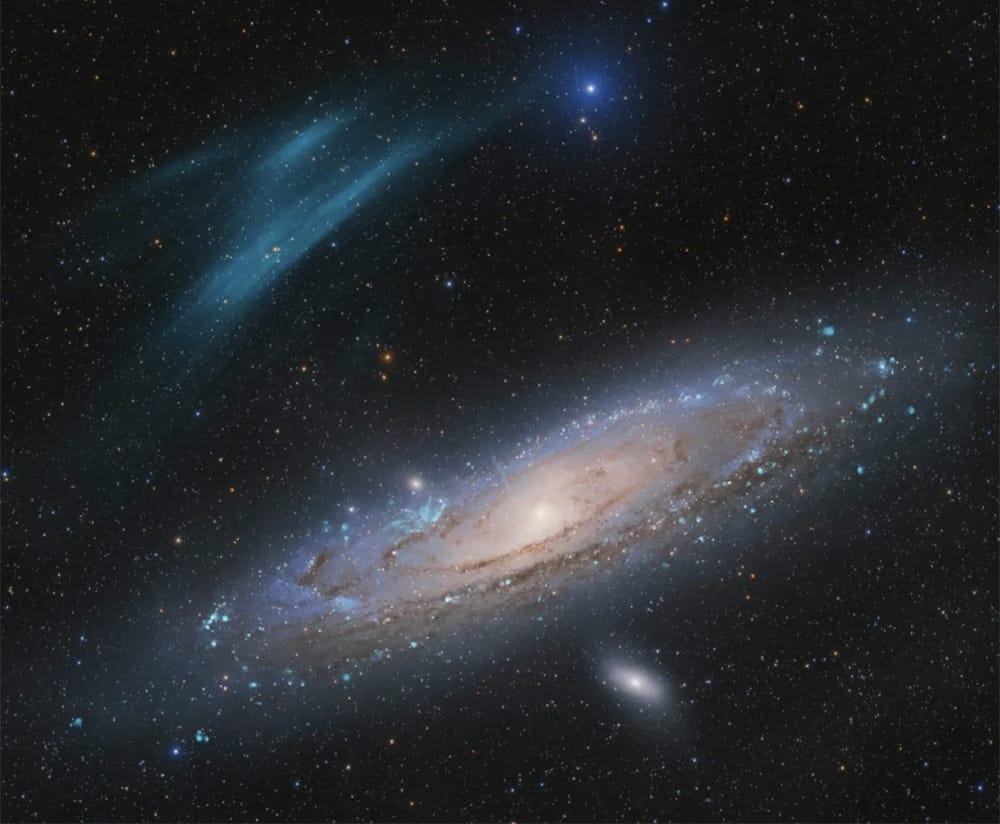
The Andromeda Galaxy (bottom) and its mysterious clouds (blue, upper left). Credit: Marcel Drechsler, Xavier Strottner, and Yann Sainty
However, new results just published may have solved this conundrum: extremely deep images and spectra show, in several ways, that the gas is far more likely to be inside our Milky Way and not affiliated with Andromeda at all [link to journal paper].
The key to this is velocity. The Andromeda Galaxy is moving toward our Milky Way at about 100 kilometers per second (though, despite most discussions on this topic, a collision is not inevitable). Because the Sun orbits around the center of the Milky Way and adds its velocity to Andromeda’s (like two cars approaching each other have a relative speed that’s the sum of both their ground speeds), we measure Andromeda’s velocity as about 300 km/sec toward us.
If the nebula is associated with Andromeda it should have a similar measured speed. If it’s inside our Milky Way, orbiting along with the Sun, it should have a far lower speed.

Join over 4 million Americans who start their day with 1440 – your daily digest for unbiased, fact-centric news. From politics to sports, we cover it all by analyzing over 100 sources. Our concise, 5-minute read lands in your inbox each morning at no cost. Experience news without the noise; let 1440 help you make up your own mind. Sign up now and invite your friends and family to be part of the informed.
The way we measure speeds of cosmic objects is to take a spectrum. This breaks the light up into individual wavelengths (or colors), sometimes thousands of them, and that reveals a lot of information about an object. For example, different elements like oxygen and hydrogen emit light at very specific wavelengths. But if they are moving toward or away from us there’s a Doppler shift which changes that wavelength. If that can be measured, the speed of the gas can be determined.
That’s easier said than done in this case because the gas is so faint. But the astronomers in the new work used the huge 10.4-meter Gran Telescopio Canarias with a camera called Multi-Espectrógrafo en GTC de Alta Resolución para Astronomía (or MEGARA, which I assume they named after the first wife of Hercules) that can take deep spectra.
What they found is pretty conclusive: the gas is moving toward us at speeds of around 10 – 30 km/sec, which is far, far less than the expected velocity of 300 km/sec, but just what you’d expect for gas inside our own Milky Way. Also, the gas is all moving at about the same speed, while if it were a huge structure blown out by the Andromeda Galaxy you’d expect to see a huge mix of velocities in the gas. If this new work is correct — and I think it is — this means the cloud is more likely a few hundred or thousand light-years from us, not millions. It also means the cloud is much smaller, maybe a few tens of light-years long, not hundreds of thousands.
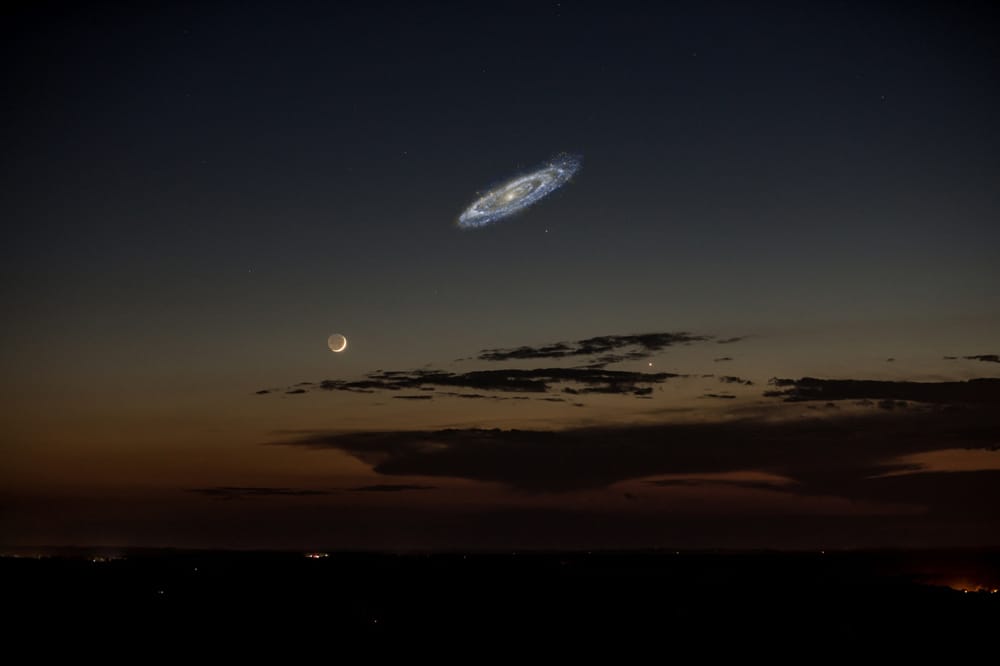
To give you a sense of how big Andromeda is in the sky, this shows you how it would look if your eyes were more sensitive. This is a composite photo from a viral picture in 2014. Credit: Tom Buckley-Houston
There’s more, too: they did in fact find hydrogen in the nebula, though at lower levels than you’d expect for an intergalactic gas cloud. The ratio of hydrogen to oxygen in the gas is consistent with some filaments of gas seen in the Milky Way, which are extremely tenuous structures of material likely ejected from stars and possibly supernovae that have slowed to a near-stop after hundreds of thousands of years. The gas is then probably excited (that is, hit by ultraviolet light which makes their electrons jump up to higher energy levels, which then lose that energy by re-emitting light causing the gas to glow) by ambient starlight. That excitation is really hard to explain if this gas is extragalactic.
They note that there was an idea proposed that the gas was ejected by a star in our galaxy called EG Andromedae, a binary star consisting of a red giant and a white dwarf, which may be blowing out a wind of particles. However, again the speed of the gas in the nebula is too low to be consistent with this, and we’d also expect to see indications of shock waves in the gas as it slams into the other gas floating around in the galaxy, and that’s not seen either.
Still, the most likely explanation is that this is filamentary gas inside our own Milky Way, just coincidentally near the position of Andromeda in our sky. That’s still pretty cool! And it strongly suggests that there’s more gas like it waiting to be found. That’ll take extraordinarily deep surveys of large swaths of sky, which is currently easier for amateur astronomers to do with smaller ‘scopes that have wide fields of view. I wonder though: as more interest is stirred up in things like this, bigger telescope could be used to do these surveys as well. I wonder if we’ll be seeing that happen in the next few years?
Et alia
You can email me at [email protected] (though replies can take a while), and all my social media outlets are gathered together at about.me. Also, if you don’t already, please subscribe to this newsletter! And feel free to tell a friend or nine, too. Thanks!
Reply