- Bad Astronomy Newsletter
- Posts
- No, you weren’t hit by 50,000 volts
No, you weren’t hit by 50,000 volts
A rant about the misuse of scientific units

Philip Plait
January 12, 2026

The Trifid Nebula and environs. Credit: RubinObs/NOIRLab/SLAC/NSF/DOE/AURA
January 12, 2026 Issue #983
A shocking misconception
This kind of thing gets me amped up
I was fooling around on TikTok recently, and the algorithm, for whatever algorithmy reason, showed me a video about someone who was accidentally electrocuted. The narrator in the video said, “… he was hit with 50,000 volts of electricity”.
<sigh>
OK, look. I’ve been debunking bad science for a long time, and in the annals of misconceptions this one isn’t that big a deal, but it is incredibly common in movies and TV shows. It grates on me and I’ve had enough. Here’s the problem.
Volts is a unit of potential, not charge. Using it in this manner, which everyone everywhere does, is wrong.
Think of it this way: if I drop a one-kilogram rock on your foot from a height of one millimeter, it’ll hurt, but the damage (except perhaps to our relationship) will be minimal. But if I purposely drop a one-kilogram rock on your foot from a height of one hundred meters I will likely be charged with murder.
The mass (or weight) of the rock didn’t change. What changed was the velocity at which it hit you. A rock moving rapidly has more kinetic energy, the energy of motion, and when it hits you that energy is transferred to your foot. The force of impact is much higher at higher speed, as is the pressure it exerts on you — falling from 100 meters, enough to do a serious amount of damage to your foot. So, the higher the rock is dropped from, the more force it can exert.
In physics, we say that the higher the rock is, the higher its potential energy; the more energy it will have when it impacts. This potential energy is converted into kinetic energy as the rock falls and accelerates.
The damage it can do depends on the mass of the rock too, of course. A grain of sand that hits you from a decent height won’t hurt. A three-meter rock hitting you at walking speed will knock you down, but one hitting you at airplane cruising speeds won’t leave enough of you for identification.
Now, if you were hit by a rock, you wouldn’t say, “I was hit by a height of 100 meters!” because that makes no sense. Conversely, saying you got hit by a pingpong ball doesn’t sound bad, unless it was launched out of a cannon. That’ll leave a mark.
It’s the same for electricity. Volts are a potential, how much energy you can give to a moving charge. We can measure charge in a unit called coulombs (analogous to the mass of the rock in the earlier example), and the current (the rate at which the coulombs flow) in amperes (usually called amps). Amps actually tells you the amount of electricity hitting you. How hard it shocks you depends on the voltage (not a perfect analogy but I admit I’m being a little loose with it here).
A milliamp at low voltage is no big deal. A milliamp at extremely high voltage could theoretically be fatal. So the voltage just tells you potentially how much damage you might get, but it’s the amperage and voltage together that tells you what that damage is likely to be.
So yeah, 50,000 volts is a lot, and even a small current can kill at that potential. But without knowing the actual current it doesn’t mean anything.
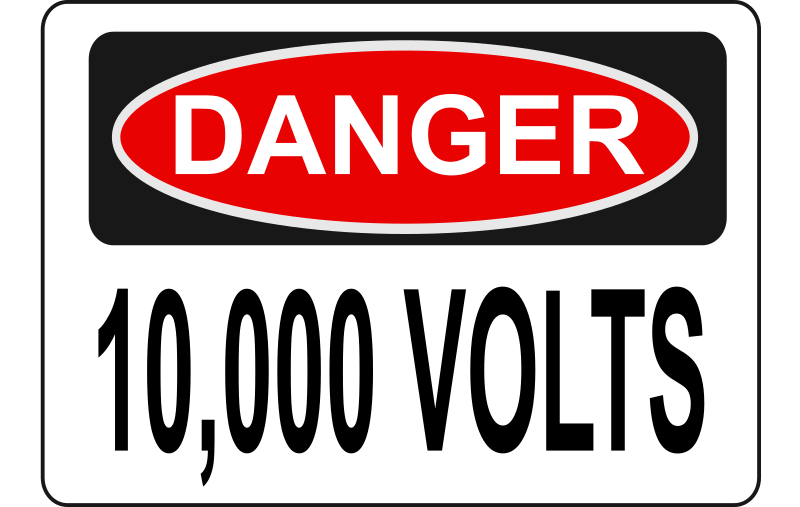
Zzzzzzzzt. Or not. Credit: Rfc1394 at OpenClipArt
When I was in college, my first year physics prof did a fun demo. He had a voltmeter, a device which reads the potential between two metal plates. At first it read zero. Then he took a glass rod and rubbed it with a piece of cloth, giving it a small static charge. He touched the rod to one of the plates, and the voltage jumped a little. Then he separated the plates by about 10 cm. The voltage screamed up to 10,000! He asked a volunteer to touch the plates. I was about five rows back so I didn’t go, but snickered when no one dared step up. Finally, a young woman got up and reached for the meter. He grabbed her arm. “Wait! It’s ten thousand volts!” he exclaimed. She shrugged and touched one of the plates.
The meter dropped to zero as the minuscule current drained into her harmlessly, and she sat down. Many in the class chuckled nervously, but I just smiled.
I think about that demo a lot.
Anyway, that’s why I find it annoying when someone says someone was hit by X number of volts. It’s the wrong unit, like saying “I weigh one meter” or “that car is six decibels away”. It doesn’t make sense.
And, like most debunkings, I know my little rant here won’t make much difference. Even if I could get heard by more people, I’m sure I would just be met with resistance.
I learned a thing!
Not a big deal, but enough to make me go, “huh!”
While writing the above rant, I did what I thought was correct, and capitalized the word “Volts” whenever I used it.
Turns out, that’s not right. It’s a proper noun in that it was named after a person, the Italian scientist Alessandro Volta, who did a lot of pioneering research into electricity. The symbol V is capitalized, but when the word is used as a unit it’s not (unless, say, you’re starting a sentence with it). So it can be 50,000 V or 50,000 volts, but not 50,000 Volts.
That feels a bit weird to me, since we capitalize a lot of eponymic units, like Celsius and Fahrenheit… except those aren’t really units, they’re scales. We say “10 degrees Celsius”, not “10 Celsiuses”. We also use Kelvin, which is a unit of temperature equal to the units of degrees Celsius, but the scale starts at absolute 0 (or -273°C) — and we don’t say “300 degrees Kelvin”; instead just “300 kelvins”. That feels odd with temperature, but only because most people don’t use the Kelvin scale and we’re used to using the word “degrees”. I’m used to capitalizing “Kelvin” when I use it as a temperature, too, so I guess I should stop that now.
I had to laugh at myself; amperes and ohms and coulombs, units used in electricity, are named after people, too, but it doesn’t bug me to leave them lower case. Our brains can be weird sometimes.
Anyway, I fixed all the capitalizations (I think) before posting this, and I’ll try to remember this rule in the future. That should fix my current usage.
Et alia
You can email me at [email protected] (though replies can take a while), and all my social media outlets are gathered together at about.me. Also, if you don’t already, please subscribe to this newsletter! And feel free to tell a friend or nine, too. Thanks!
Reply