- Bad Astronomy Newsletter
- Posts
- Red Planet special: HiRISE’s 100,000th image, and Martian crepuscular rays
Red Planet special: HiRISE’s 100,000th image, and Martian crepuscular rays
Big milestone for a Mars mission, and a weirdly familiar sight in the Martian sky

Philip Plait
January 05, 2026

The Trifid Nebula and environs. Credit: RubinObs/NOIRLab/SLAC/NSF/DOE/AURA
January 5, 2026 Issue #980
HiRISE’s 100,000th image of Mars!
The venerable camera has mapped the Red Planet in amazing detail
The Mars Reconnaissance Orbiter is an amazing spacecraft: launched in August 2005, it achieved Mars orbit in March 2006. Onboard is one of my favorite cameras in the solar system, the High Resolution Imaging Science Experiment, or HiRISE. This instrument is capable of taking both wide-and narrow-angle images of the surface, meaning it can map large areas as well as zoom in, so to speak, to get sharp views of smaller regions. Its half-meter mirror is the biggest ever put into orbit around another world, and can get images with a resolution of an astonishing 0.5 meters per pixel!
In other words, if you were standing on Mars, it could see you.
On October 7, 2025, it took an image of Syrtis Major, a large shield volcano that is darker than the surrounding area, making it visible even in small telescopes from Earth (I’ve seen it a few times myself with my own ‘scope). HiRISE has imaged his area many times, but what makes this one special is that it is the 100,000th image taken by the camera.

HiRISE’s 100kth. Credit: NASA/JPL-Caltech/UArizona
This wide-angle view shows a swath of Syrtis Major covered in hummocky hills. The series of parallel arcs are actually sand dunes! The volcano is very old and eroded, and the sand may be from rocks worn down by the very weak but persistent winds on the planet.
Here’s a different view of a portion of the same area, combining images in blue, red, and infrared filters to create a color image:

A closer look at an old volcano. Credit: NASA/JPL-Caltech/University of Arizona
Volcanic basaltic rock (common on Mars) is dark in visible wavelengths, but in this image, where infrared is added and shown in red, basalt looks blue. There’s also dust covering Mars that is high in iron oxide (rust!) and is red in visible light, but that’s shown using green in the image (infrared is shown in red). I know, it’s weird, but color imaging is confusing sometimes.
This image was taken as part of the HiWISH program, where members of the public can suggest spots to observe on Mars. It was submitted by a Colorado high school student! So that’s cool too. I love seeing younger folks getting active in space exploration.
This spot on Mars is only 80 kilometers from where the Perseverance rover is tooling around in Jezero Crater looking for signs of ancient life on the planet. It’s helpful to get context from space images when you also have rovers on the surface, so you can better understand the complex processes going on geologically that forged the area.
And geez, a hundred thousand images. That’s a vast amount of data… and HiRISE is still up there snapping away. Here’s to a few hundred thousand more.
Cloud dancing and crepuscular rays on Mars
The Red Planet puts on an atmospheric show
Back when I lived in Colorado I had a great view of the weather almost every day. The mountains sculpted flows in the atmosphere that created amazing clouds and other phenomena that never got old.
Turns out, Mars can throw a party as well. The Curiosity rover is still tooling away on the fourth planet, doing its science. Back in 2023 it saw something never seen before there: crepuscular rays!
Crepuscular rays on Mars! Credit: NASA/JPL-Caltech/MSSS
You’ve probably seen these on Earth; long fan-like dark shadows on the clouds, usually at sunset. That’s what they are! When I was in Colorado they were usually the shadows of mountains cast on the sky, darkening the clouds or the haze in the air. I suspect that’s what we’re seeing here.
The rays are actually parallel, even though they appear to diverge away from the horizon. That’s just perspective; like railroad tracks converging at the horizon.
This is more than just a cool photo, too. This shot was taken as part of a survey the rover did to look at clouds in the thin Martian air. The way they form and change, their height above the ground, and more, has information on how the atmosphere behaves. That’s something we couldn’t really study until we went there. Images like this really help.
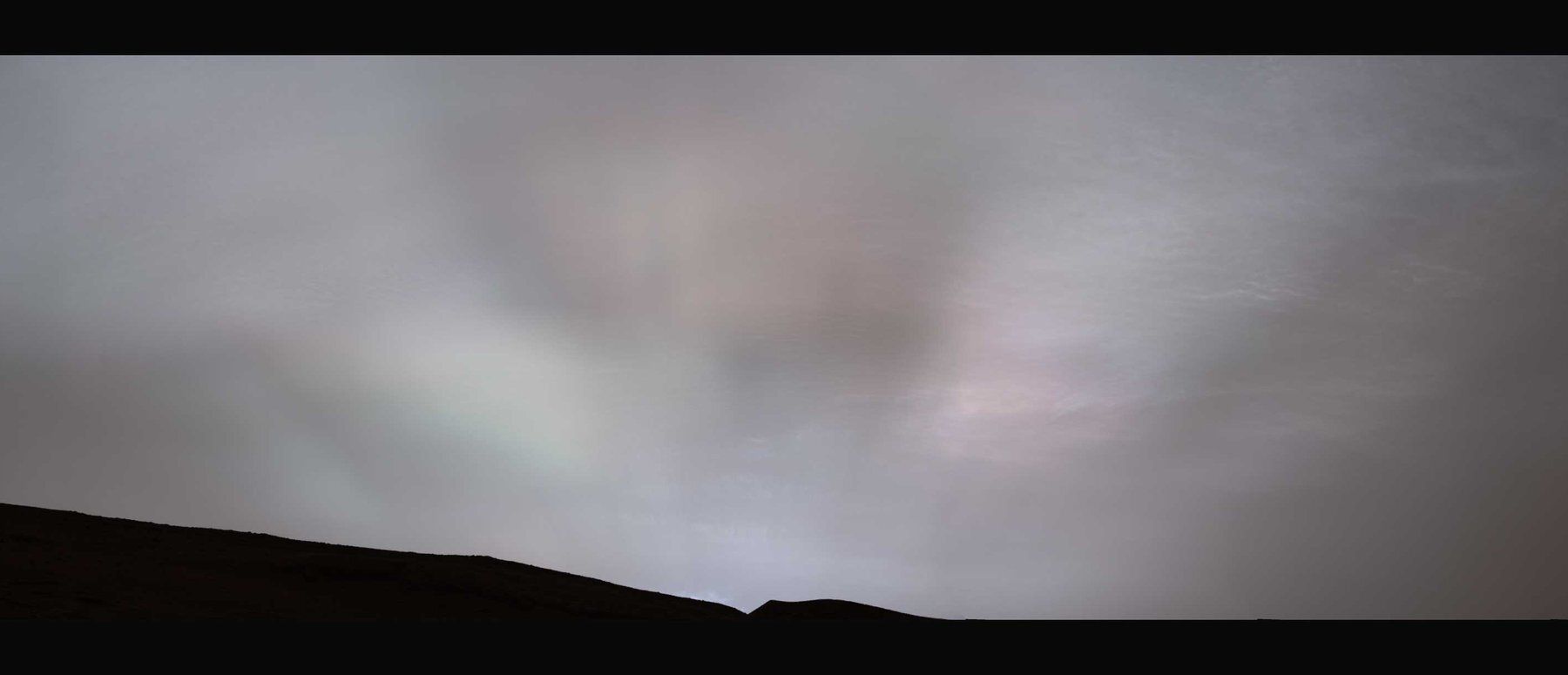
And also, because it’s another favorite of mine, the rover also saw an iridescent cloud!

Iridescence on another world. Credit: NASA/JPL-Caltech/MSSS
That’s cirrus cloud, and as sunlight passes through it the ice crystals bend the light, called diffraction. The light waves then interfere with each other, creating new colors not in a rainbow: teal, pink, and more. The colors depend on the size of the ice crystals, so that again tells scientists about what’s going on in the Martian atmosphere.
These sorts of clouds happen all the time on Earth — though in some locations more than others — and there is a vast variety of clouds that can be spectacular and awe-inspiring.
Look up. There’s a whole sky up there waiting for you to see it.
Et alia
You can email me at [email protected] (though replies can take a while), and all my social media outlets are gathered together at about.me. Also, if you don’t already, please subscribe to this newsletter! And feel free to tell a friend or nine, too. Thanks!
Reply