- Bad Astronomy Newsletter
- Posts
- SOHO’s 30th year in space, and climate change induced earthquakes?
SOHO’s 30th year in space, and climate change induced earthquakes?
Three decades of watching the Sun, plus an interesting correlation between climate and quakes

Philip Plait
December 04, 2025

The Trifid Nebula and environs. Credit: RubinObs/NOIRLab/SLAC/NSF/DOE/AURA
December 4, 2025 Issue #967
Reminder: Get the BAN for less!
20% discount runs through December 19
I don’t want to hammer this too much, but don’t forget I’m running a subscription sale of 20% off the normal $6/$60 price for the newsletter, so it’s $4.80/month or $48/ year! I figure a lot of people need last minute gifts, and it’s easy to create a gift subscription. So, please and thank you!
SOHO celebrates 30 years in the Sun
The venerable solar observatory launched in 1995
This news came as a surprise to me: SOHO launched into space on December 2, 1995, so Tuesday marked its 30th year in space! It’s a surprise because geez, that’s a long time ago, but also geez, I remember when it launched.
The NASA/ESA Solar and Heliophysics Observatory was an ambitious mission, designed to stare at the Sun continuously, day in and day out, measuring it with a fleet of scientific instruments, including LASCO, the Large Angle and Spectrometric Coronagraph, which took wide-angle shots of the Sun. It had a wedge of metal in it that blocked the Sun’s direct light, allowing the fainter parts of the Sun like its corona to become visible.
Sometimes, when the Sun was feisty, blowing out a big flare (a highly local but extremely powerful magnetically induced explosion) or a coronal mass ejection (larger and fainter but still flinging out a billion tons of hydrogen gas at disturbingly high velocity) — I explain more about these in BAN #582 — the LASCO image would get covered in cosmic ray hits, subatomic particles slamming into it and creating thousands of bright pixels all over it. That always gave me the creeps; those particles play havoc with electronics, and in sufficient quantity don’t play well with human cells, either. Our atmosphere protects us, but astronauts have to take cover in a protected area of the space station to make sure they don’t get too big a radiation dose.
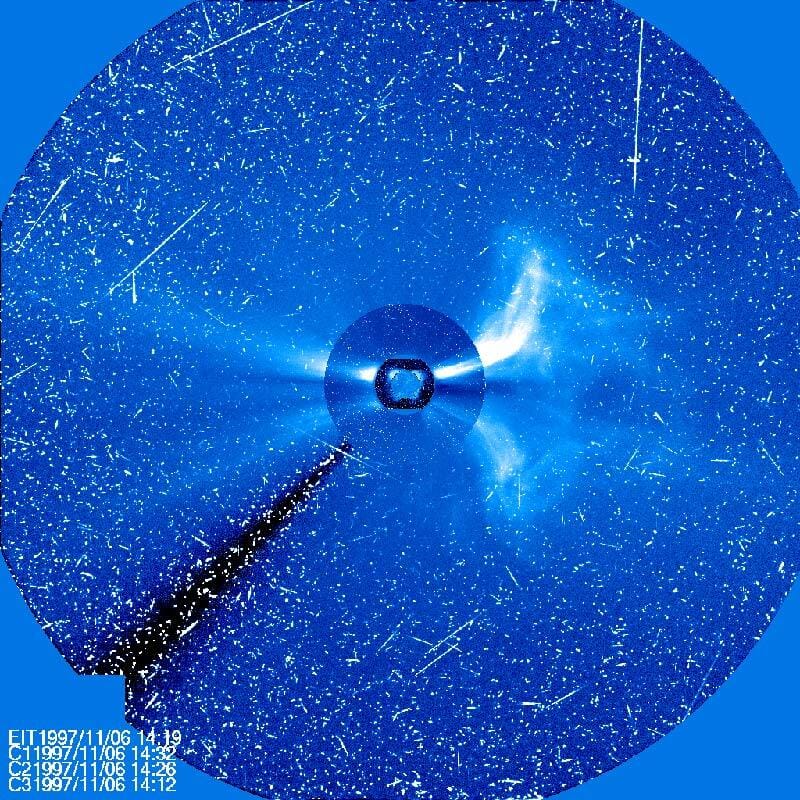
A CME in November 1997 blasted SOHO with subatomic particles, creating this salt-and-pepper image. Credit: SOHO/LASCO consortium
Speaking of which, I remember the immense solar storms of the early 2000s, like the Bastille Day event in July 2000 and the Halloween storms of 2003. That latter one was truly terrifying; one flare was estimated to be an X45 on the scale, which made it one of the most powerful ever seen. Smaller flares can cause blackouts and such, and this one did play havoc with communications and it interacted with Earth’s atmosphere. The SOHO observations of these events were crucial in understanding the underlying physics.
As for the launch date… I had just defended my PhD in 1994 and gotten a job at a contractor for NASA’s Goddard Space Flight Center when SOHO launched. Later, when I got another job at Goddard, I would sometimes walk the halls and talk to other scientists (I had a difficult time focusing on work for eight hours straight every day), and many of them worked on solar astronomy. Many are also still friends today, and it’s interesting and a bit nostalgic to think back to those times when SOHO was the most sophisticated observatory to watch the Sun. And it’s still up there, between Earth and the Sun at the L1 point, sending back important information to help us study our nearest star. Literally our technological civilization depends on this, so I’m glad the old observatory is still ticking away.
Congrats to the thousands of people involved with this mission, and may it continue to keep an eye on Sol for a long time to come.
Climate impact on earthquakes?
Scientists find an (and very specific) interesting link
I am not an expert in either of these fields, so take this with a grain of salt, but a team of scientists claims they have found a link between climate and seismic activity. The catch is, it’s occurring in a single specific place. Still, if this pans out, it’s pretty cool.
The spot is Lake Turkana in Kenya, which is on the East African Rift Valley, a long crack in the ground where two continental plates are moving apart. As climate patterns in the area change, the lake has water levels that fluctuate dramatically; thousands of years ago, for example, the water level was 100 meters higher than it is now.
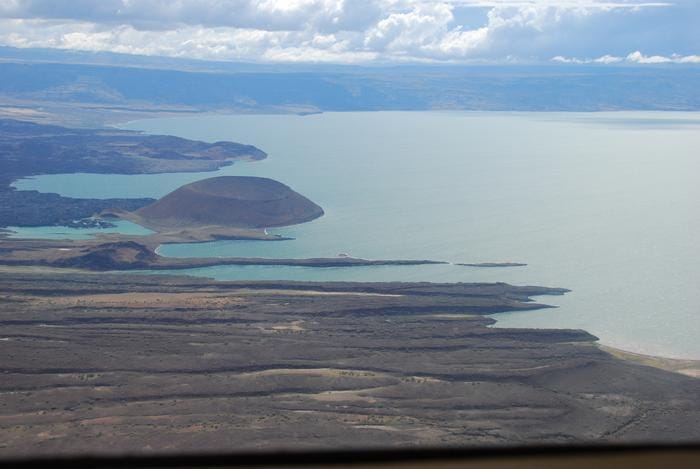
Lake Turkana in Africa. That mound sure volcanic to me. Credit: Chris Scholz, Syracuse University
The team sampled the subsurface volume under the huge lake at many locations, and after analyzing them found a curious pattern: the fault lines moved and magma under the surface increased when the lake was dry, and decreased when the lake was more full. They posit the pressure of the water when the lake is fuller affects the seismic conditions under the lake.

Subscribe to Premium to read the rest.
Become a paying subscriber of Premium to get access to this post and other subscriber-only content.
Already a paying subscriber? Sign In.
A subscription gets you:
- • Three (3!) issues per week, not just one
- • Full access to the BAN archives
- • Leave comment on articles (ask questions, talk to other subscribers, etc.)
Reply