- Bad Astronomy Newsletter
- Posts
- The Red Spider Nebula: JWST’s view of gorgeously dying star
The Red Spider Nebula: JWST’s view of gorgeously dying star
In stellar death lies great beauty, and amazing science

Philip Plait
March 30, 2026
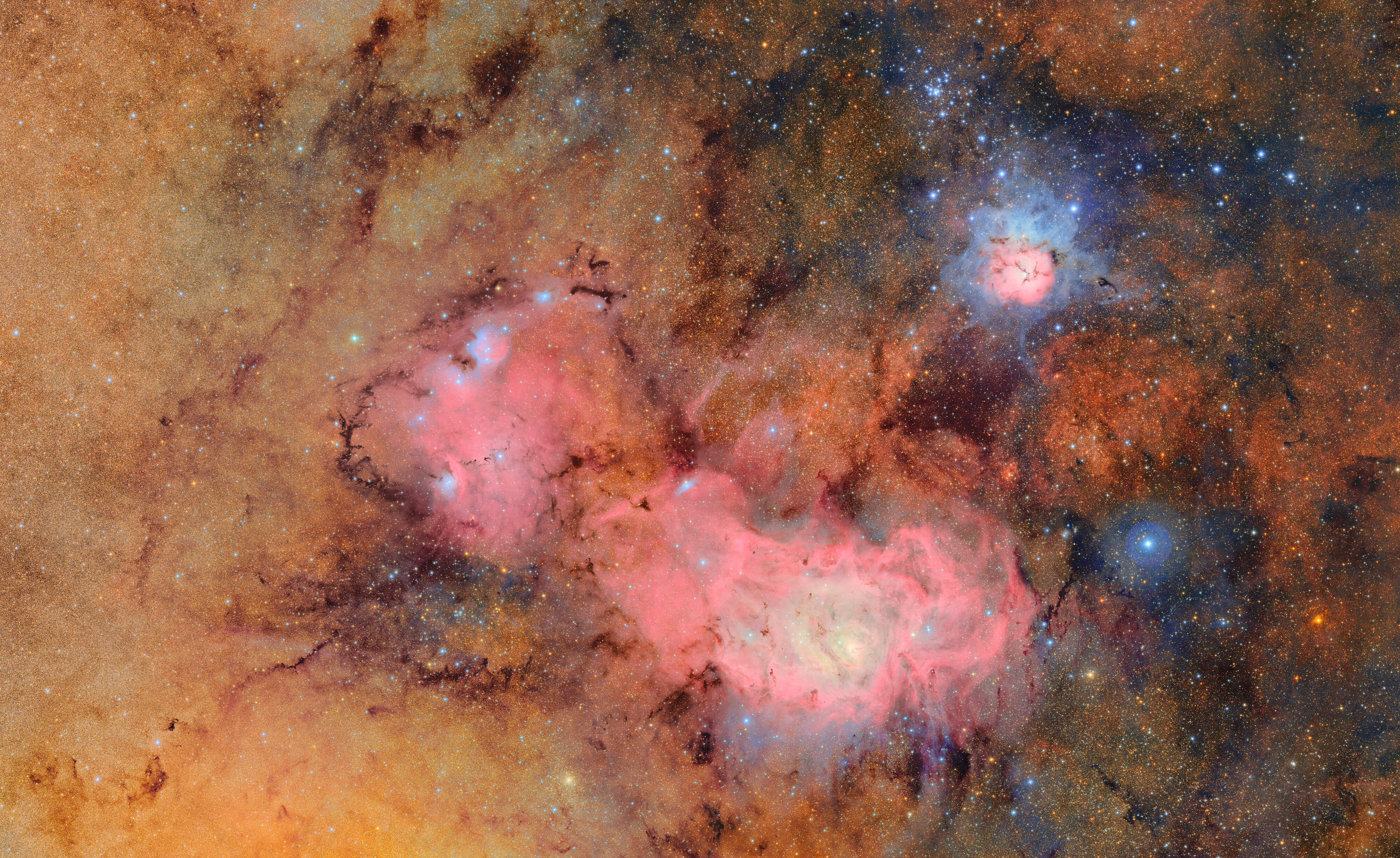
The Trifid Nebula and environs. Credit: RubinObs/NOIRLab/SLAC/NSF/DOE/AURA
March 30, 2026 Issue #1016
The phenomenal awesomeness of the Red Spider Nebula
Ho hum, just another staggeringly ridiculous image from JWST
Look, hey, I know I’m biased. Back in the day I studied planetary nebulae — the gas shed by dying stars subsequently lit up by the exposed hot stellar core — for many years, so I have a predilection for them. They’re fascinating objects, and given the sun may create one some seven or eight billion years from now makes them even more interesting.
But also? They’re fantastically beautiful. And, as a scientist, I can offer you proof.
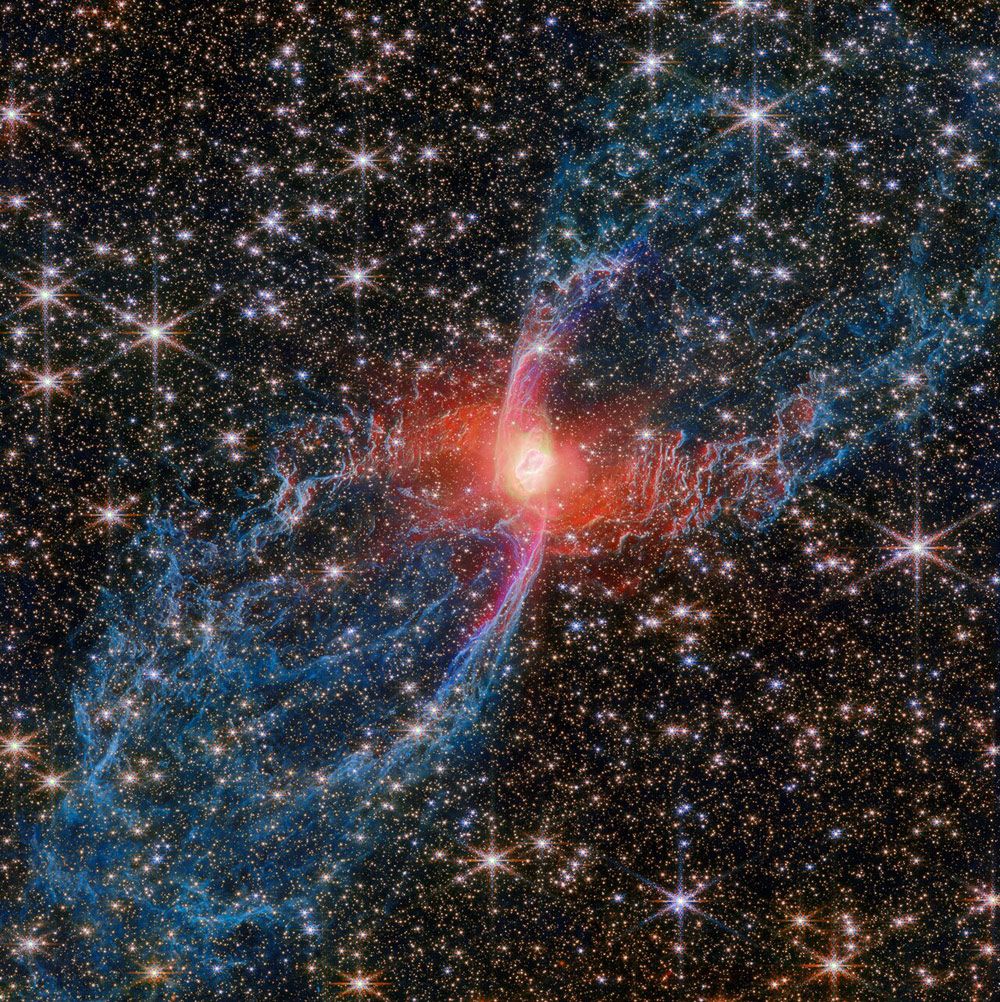
Yeah. I mean, seriously, wow. Credit: ESA/Webb, NASA & CSA, J. H. Kastner (Rochester Institute of Technology)
WHAT THE ACTUAL WHAT. Holy moly.
That is NGC 6537, aka the Red Spider Nebula. The distance to it is not clear, but it’s likely in the 5,000-light-year range. This image was taken using JWST, and to understand what you’re seeing you have to understand planetary nebulae a bit.
I’ve written about them many times; the basic idea is that as a star runs out of fuel in its core it turns into a red giant and sheds its outer layers. Eventually so much material is lost that the core of the star, now a white dwarf, is exposed to space, and zaps the gas with ultraviolet light, causing it to glow.
But the devil’s in the details, and there are devils aplenty in the Red Spider [link to journal paper].
For one thing, what happens in the core as the star dies is pretty complicated. I go over this in a pair of Crash Course episodes (Low Mass Stars, and White Dwarfs and Planetary Nebulae), but here’s a synopsis.
Stars are usually powered by fusing hydrogen into helium. The helium builds up in the core, getting denser and denser. When the available hydrogen in the core runs out, the helium is so dense that a weird quantum mechanical effect takes over — called electron degeneracy — and causes the helium to heat up a lot, way hotter than even the core was before. This causes hydrogen to fuse in a thin shell around the helium core at a furious rate, making even more helium that falls into the center. Eventually there’s enough helium that it begins to fuse. A truly colossal flash of energy ensues, which inflates the helium core and takes away the degeneracy. But now it’s fusing helium into carbon, and the whole running-out-of-fuel process repeats. It might actually repeat several times with heavier and heavier elements if the star is massive enough.
Every time the core changes, the outer layers do as well. All the extra energy from the hot degenerate core flows upwards, heating the outer layers and causing them to inflate. The star is so luminous and the outer layers so tenuous that the gas in the upper part can get blown away from the star. This is called the red giant wind.
When the core starts up fusion again the star will shrink, since less energy is flowing outward, only to expand again when the fused material builds up and gets degenerate. Eventually the star reaches the asymptotic red giant stage, where it gets truly huge. By this point it’s blown away a lot of gas, so much so that this stage doesn’t last long. The hot core is now becoming a white dwarf and dominating the upper layers, and the gas blown off is much more energetic, moving far faster. It slams into the previously ejected slower-moving gas, creating the phenomenal and weird shapes we see in planetary nebulae.
OK, so the Red Spider. The outer lobes in the hourglass shape (colored teal in the JWST image) are from hydrogen, blown out when the star was a red giant. It’s a bit hard to differentiate in the image, but there’s also an S-shaped teal structure extending to the bottom and top of the image along the edge of the lobes; that’s from iron that’s been ionized, losing a single electron. This is common in shock waves, when fast moving gas hits slower material; in this case the faster wind from the pre-white dwarf core ramming the slower material ejected earlier. The slow stuff is expanding at about 18 kilometers per second, and the fast wind at more like 350. That’s fast. It hits the slower stuff and inflates it, creating the huge lobes that are each about 4 light-years across end-to-end (quite large for a planetary). These structures are likely about 3,700 years old.
That’s a bit easier to see here, in a figure from the paper:
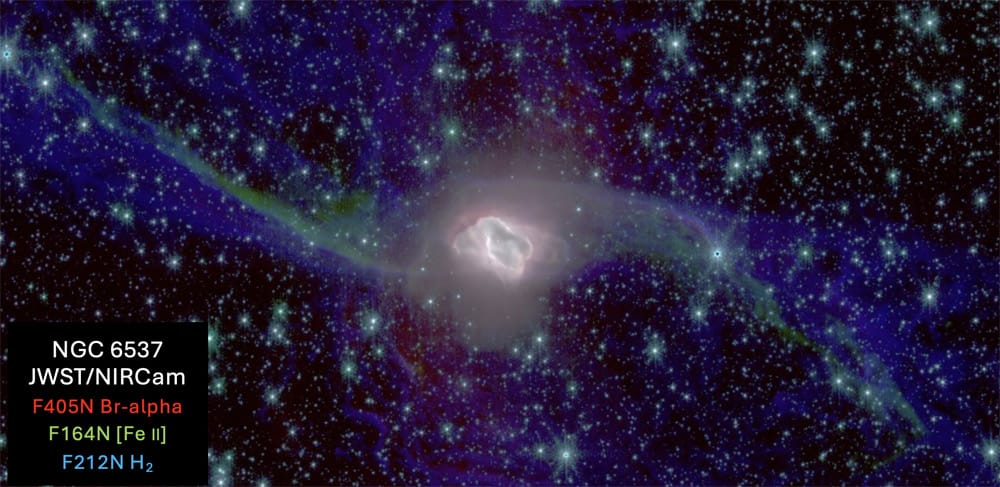
The S-shaped structure showing iron and hydrogen in the nebula, rotated 90° clockwise. Credit: Kastner et al. 2025.
Here the iron is green, while hydrogen is red and blue.
The inner structure is more complicated (it’s also seen in Hubble Space Telescope images). That’s from material ejected when the star was an asymptotic giant, right before the white dwarf was exposed. It forms a thick dusty torus (a doughnut shape) around the star, opaque to visible light, but which is easier to investigate in infrared. It’s expanding at about 10 km/sec, so it’s probably about 10,000 years old. It formed before the lobes started getting hit by the fast wind, and may have helped focus the gas to blow “up and down” instead of in all directions.
The extreme elongated shape of the nebula overall is almost certainly due to the presence of another star that was a binary companion to the now white dwarf. When the first star started to die the binary motion may have made it spray material into that thick torus in the plane of the orbit due to centrifugal force. When the fast wind started up, it hit the torus and slowed, but stuff sprayed up and down was free to move, and hit the older gas.
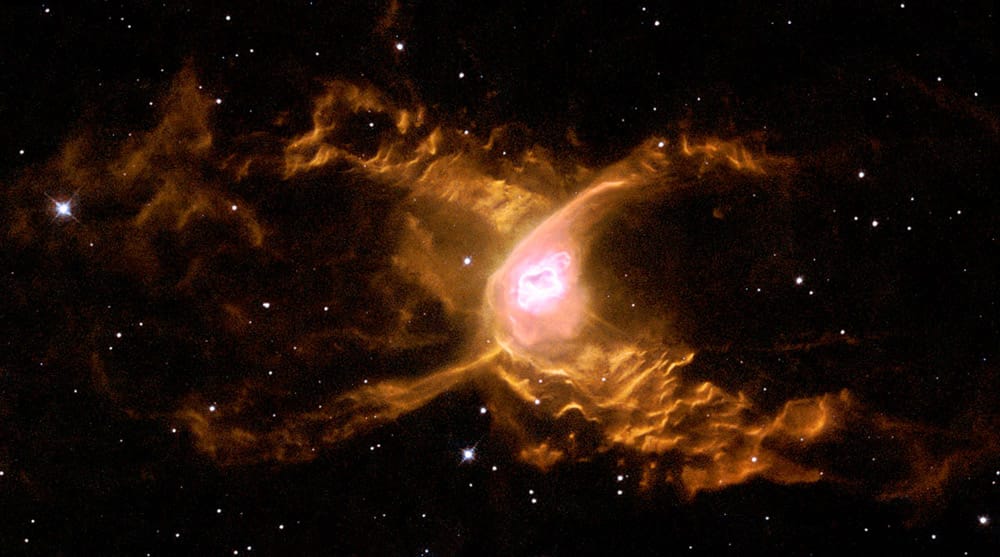
Hubble’s view of the Red Spider; red is light from sulfur, orange from nitrogen, with hydrogen in green and blue. Credit: ESA & Garrelt Mellema (Leiden University, the Netherlands)
The white dwarf is hot, probably around 250,000°C. That implies it’s massive, and may be about the mass of the sun (squeezed into a ball the size of Earth!). That in turn means the original star was more massive than the sun, probably by a factor of 3 – 7. This is likely why this nebula is extreme in so many ways; such a massive star means more energy, pushing harder on the expelled gas, making the central stars hotter, and more. When the sun turns into a planetary nebula it won’t be anywhere near as elongated or as hot. Or as big! The Red Spider is huge as these things go.
So, all in all a very cool object to study (and it’s nice to see my old friends Bruce Balick and Noam Soker involved with this study). And it’s also just dead spectacular. I almost don’t envy the scientists studying it; all those stars in the background would make a detailed analysis tough, but gee, what a thing to have to stare at for work! I do miss digging into observations like this a bit… but honestly I’m happy just to boggle at it and explain it to all y’all. That’s fun too.
Et alia
You can email me at [email protected] (though replies can take a while), and all my social media outlets are gathered together at about.me. Also, if you don’t already, please subscribe to this newsletter! And feel free to tell a friend or nine, too. Thanks!
Reply