- Bad Astronomy Newsletter
- Posts
- Two JWST stories: an incredible nebula/star cluster image, and a map of dark matter
Two JWST stories: an incredible nebula/star cluster image, and a map of dark matter
Westerlund 2 is a feast for the eyes, and the dark matter map a feast for the brain

Philip Plait
April 02, 2026

The Trifid Nebula and environs. Credit: RubinObs/NOIRLab/SLAC/NSF/DOE/AURA
April 2, 2026 Issue #1018
Westerlund 2: Another JWST jaw-dropper
It’s a lot of stars.
Westerlund 2 is a massive star cluster. Located about 20,000 light-years from Earth, it’s surrounded by a nebula (called RCW 49) roughly a dozen light-years across — so, in the same category more or less as the Orion Nebula. Unlike Orion, though, it’s not forming hundreds if stars, it’s forming thousands. Westerlund 2 has at least 2,000 stars in it, about 20 of which are O-class monsters blasting out hundreds of times the energy of the sun each.
There are also low-mass stars in it, as well as brown dwarfs, objects more massive than planets but too low-mass to ignite hydrogen fusion in their cores, so not real stars.
Astronomers pointed JWST at the cluster to investigate these smaller objects, and what it saw was just phenomenal.
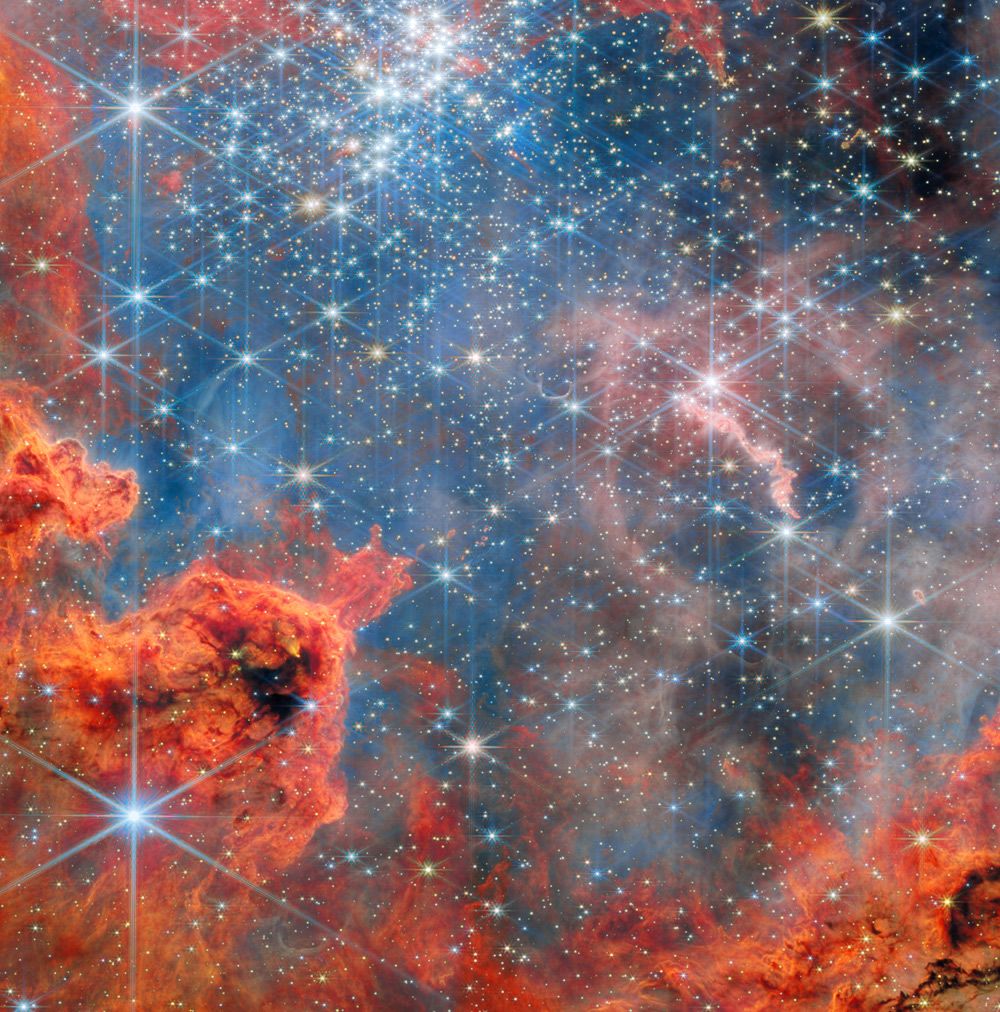
Westerlund 2, seen by JWST. Credit: ESA/Webb, NASA & CSA, V. Almendros-Abad, M. Guarcello, K. Monsch, and the EWOCS team.
Holy smokes! Click here for the much larger 4,125 by 4,175 pixel version that will pop your eyeballs out.
The cluster is at the top of the image. It sits in a cavity carved out of the gas by the stars themselves; those bigger ones blast out ultraviolet radiation that eats away at the gas, and pushing it away from the stars to form the inside of a bubble.
The image is in infrared, but the colors have been converted to the colors we can see to display them. Blue shows cool stars, green methane gas, and red shows things like methane, cool objects like brown dwarfs, and dust grains made of long chains of carbon atoms (called polycyclic aromatic hydrocarbons, or PAHs; literally basically soot).
These observations were taken to see if the population of brown dwarfs in the cluster is affected by the intense radiation from the superluminous stars; as objects form, the radiation blast can strip away material, possibly making more brown dwarfs because it robs material from stars trying to get bigger. Or it could blow all the material away, creating a deficit of low-mass objects. They saw enough brown dwarfs to analyze, though. I haven’t seen a paper published with the observations yet, though so I can’t say much.
I’ve written about this cluster before, both in my very first newsletter as well as back on SYFY, where I talk about forming planets is hard in clusters like Westerlund 2 for this very reason.
The first brown dwarfs were discovered only in the late 1990s — I remember this, as I was working on Hubble not long after, and studied them for awhile. Finding them was hard, because they’re very faint and produce most of their light in the infrared, where even Hubble doesn’t see well. Now we can point JWST at a nebula and find dozens or even hundreds of them at a time!
Progress, baby. I love it. Not only do we get dynamite photos of space, but we learn so much about it, too, things we could only guess at just a few years ago. Progress!

Subscribe to Premium to read the rest.
Become a paying subscriber of Premium to get access to this post and other subscriber-only content.
Already a paying subscriber? Sign In.
A subscription gets you:
- • Three (3!) issues per week, not just one
- • Full access to the BAN archives
- • Leave comment on articles (ask questions, talk to other subscribers, etc.)
Reply