- Bad Astronomy Newsletter
- Posts
- View from a height: The Earth from Artemis II
View from a height: The Earth from Artemis II
Moon-bound astronauts get a gorgeous shot of home, with lots of fun details

Philip Plait
April 06, 2026

The Trifid Nebula and environs. Credit: RubinObs/NOIRLab/SLAC/NSF/DOE/AURA
April 6, 2026 Issue #1019
Earth from space: delightful Artemis II photos of our home world
There’s a lot to see from a few thousand kilometers away
Hello, Earth
Hello, Earth
With just one hand held up high
I can blot you out, out of sight
Peek-a-boo, peek-a-boo, little Earth
On April 1, 2026, the crew of the Artemis II lunar mission launched into space. Today (Monday, April 6) they will swing around the far side of the moon (NOT the dark side, although in this case it mostly is due to the waning gibbous phase, but I’ll just leave that alone!) and at closest approach will be only about 6,500 kilometers from its surface. After that they’ll start to head back to Earth and are expected to splash down in the Pacific Ocean on April 11.
You probably already know this is the first crewed lunar mission in 50+ years, and a lot of firsts will be achieved during the flight. I have a lot of opinions about this mission, NASA’s plans, and the rocket itself being used, but that’s not what I want to focus on here. Instead, let’s look at something very cool indeed.
After launch, the spacecraft was in Earth orbit, a sort-of parking orbit until they were in the right position to ignite their engines for a translunar injection burn that sent them up and away from our home world and on their way to the moon. Not long after that was done, astronaut Reid Wiseman pointed a camera out the capsule window and took a truly amazing photo of Earth:
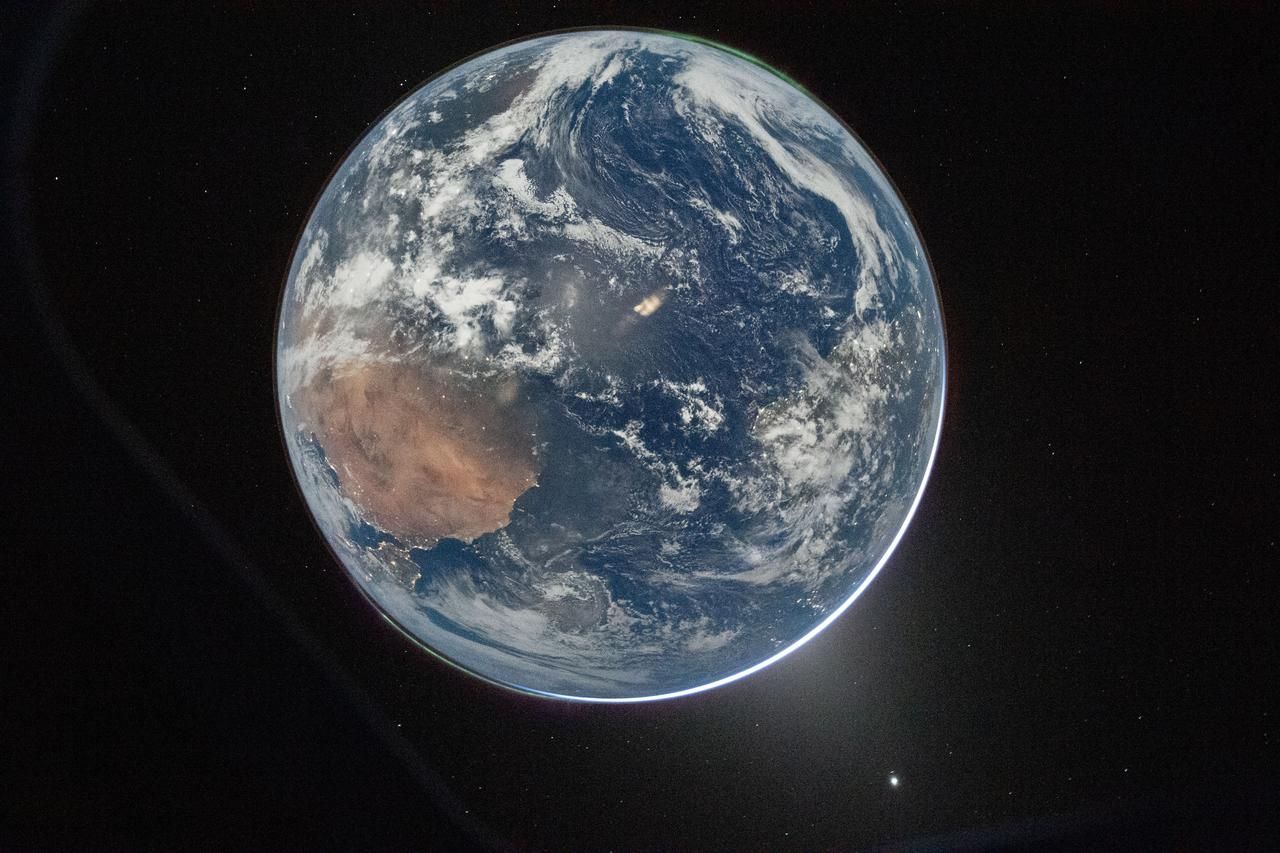
Hello, Earth. Credit: Reid Wiseman/NASA
[Click the photo to see much higher-resolution versions where the stars and more are clearly visible.]
That’s fantastic. It spread like wildfire online, unsurprisingly, with a lot of people asking about it, curious about what they were seeing. Some of the information being shared was great, some incorrect, and some didn’t give the full picture. I’ll try to fix that!
First, this shot of Earth is not lit by the sun. So what’s lighting it up then?
The moon! It was full, and the full moon is pretty bright — you can read by it. What you’re seeing is light from the sun reflected off the moon, hitting Earth, and reflecting back up into space where the astronauts could see it.
When this shot was taken the sun was directly behind Earth, completely blocked out. However, it wasn’t centered behind it but instead a bit closer to the lower right side as seen here — if you look that way in the photo you can see a bright sliver, a very thin crescent. That’s sunlight passing through Earth’s atmosphere and lighting it up (it’s not the actual surface being lit by the sun)! The digital camera (a Nikon D5) was set for a ¼ second exposure at f/4 with an ISO of 51,200, which makes it very sensitive to light. The moonlit Earth is therefore exposed well, but the sunlit air to the right is overexposed.
If we were looking at Earth’s dayside here, it would vastly outshine the stars, which would be completely invisible. We see stars, so this must be the night side.
Wiseman took another shot about 20 seconds later at a 1/15th of a second exposure that makes it more clear this was taken over the unlit side:
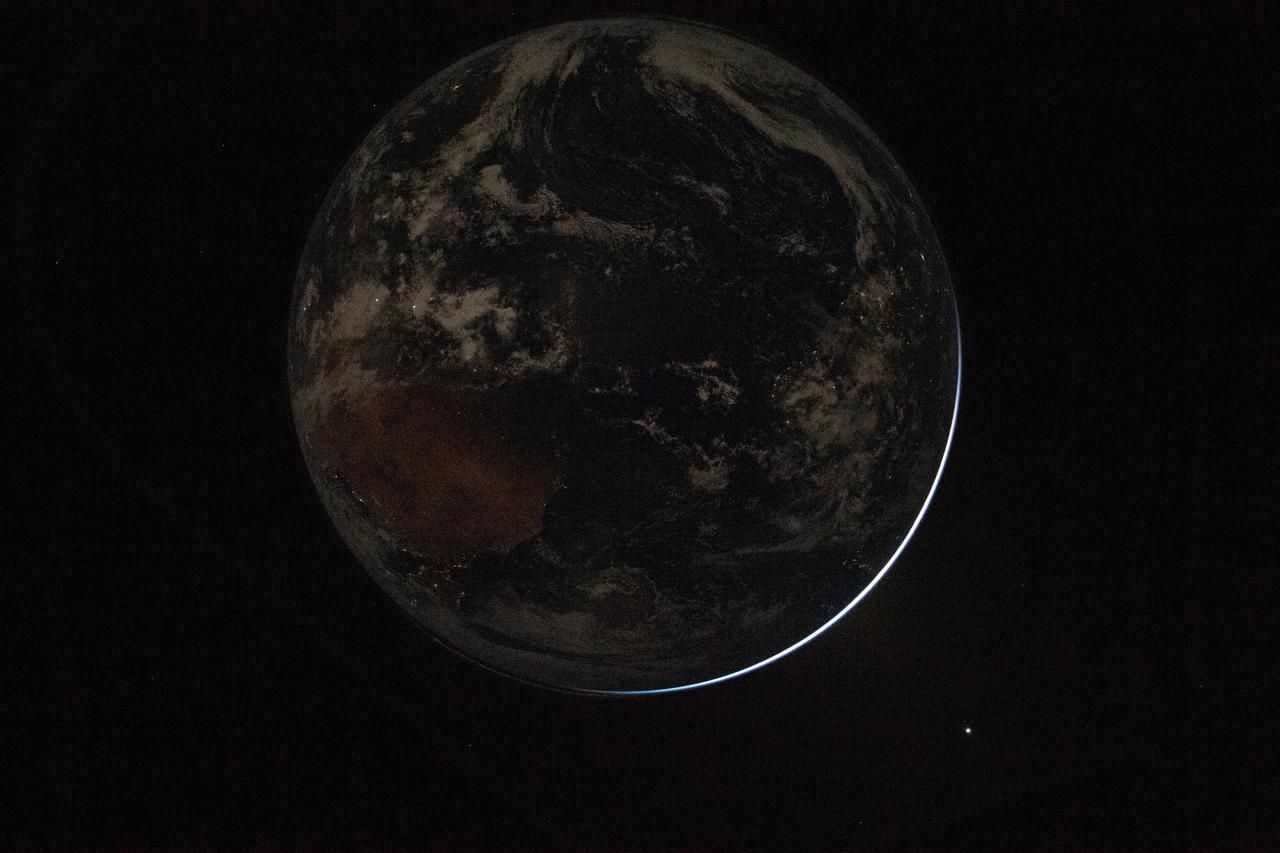
Same as above, but Earth is much darker. Specks of light can be seen across Earth. Credit: Reid Wiseman/NASA
Cooool.
As for Earth itself, the center of the disk is over the Atlantic Ocean west of Africa, with that continent looming large to the left, dominated by the brown tones of the Sahara Desert. Just below it is Spain and Gibraltar. On the far right South America is visible through the clouds — I’m pretty sure the specks of light across the face of Earth in the shorter exposure photo are cities in South America and Africa. Note that south is up here; we’re used to seeing maps the other way around, but in space up and down are relative. I’ve seen some folks displaying this photo with north up, which I get, but I prefer it this way, how the astronauts saw it. Remember: they were in space when this was taken. It’s always good to shake up your perspective a bit.
The odd glow just above and to the right of center is very likely a reflection of light off the cabin window. If you ramp the brightness up in the photo you can see the edge of the window frame on the left of the photo, too.
Speaking of perspective, a tricky aspect of this is that they weren’t all that far from Earth when the photo was taken, so you’re not seeing the entire hemisphere. Think of it this way: the horizon is only a few kilometers away from you when you’re standing up in a relatively flat area (like a beach), so your view is limited. The higher up you go, the farther the horizon is and the more of the planet you see, and when you’re really far away (technically infinitely far away, but, say, a hundred thousand kilometers is enough) then you’re seeing essentially the entire hemisphere of the planet.
Here, they were too close to see the whole thing. Judging from the stars (which I’ll get to in a sec) Earth is roughly 45° across, so doing the trig they were about 8,500 km away (measured from Earth’s surface in the center of the image) at that moment. Enough to see a lot of the planet, but not the complete hemisphere. The camera was using a 22 mm focal length, which is a wide angle, wider than you usually see in a normal cell phone camera, for example, which is why Earth only fills about half the frame.
Sticking with Earth for a moment more, look to the top and bottom of the disk: see that green glow? That’s the aurora! It’s pretty common to see the aurora in shots taken from the ISS, but that orbits pretty low and only sees one pole at a time. Here we see both the aurora borealis (northern lights) and the aurora australis (southern lights) simultaneously!
Also, there’s a reddish-brown ring encircling the Earth at the same height as the aurora; that’s airglow: oxygen atoms energized by sunlight during the day and slowly emitting that energy in the form of light. Again, ISS photos show this all the time. It’s a thin layer of oxygen that glows this way, so it’s easiest to see when you’re looking toward the horizon from space, when your line of sight goes through the most material (called limb brightening).
Now, finally, to space. The bright “star” off the lower right edge of Earth is actually the planet Venus! I knew this right away when I first saw this shot; from the ground Venus is now appearing over the western horizon after sunset. I’ve seen it a few times through the trees this past week, and it’s slowly getting higher every night. Given the shot is looking toward the sun past Earth, I knew that had to be our evil twin planet.
You can also see an eerie glow seemingly reaching up from Earth toward Venus. That’s an illusion; it’s actually zodiacal light, the glow of sunlight reflecting off dust released by comets, so it’s actually far in the background. It’s pretty faint and difficult to see from the ground, but much easier from space.
You can also see dozens of stars in the photo, too. Given how wide the shot is and how sensitive the camera was, when I saw the photo I knew it wouldn’t be too hard to identify them. The stars near Venus are in the constellation Pisces, with Cetus to the upper right, and Andromeda to the left (the brightish star at the 7:00 position around Earth is Alpheratz, the brightest star in Andromeda; unfortunately the Andromeda Galaxy isn’t visible which would’ve been amazing). To the upper left are the stars in Aquarius — I got a kick out of that. The Apollo 13 lunar module was named Aquarius.
I’ll note that not too long after I figured all this out I saw my friend Corey Powell posted a much more detailed annotated version on Bluesky if you’re curious (the image has been flipped in that version).
Anyway, I was able to use the positions of the stars to get a rough estimate of how big Earth appears here, and then use the small angle formula to get its distance (they were about 15,000 km from Earth’s center, so subtracting its radius of 6,400 km I get roughly 8,500 km).
All of this is amazing. And there’s so much more; NASA is posting the images as they come in from space. Today the astronauts are very close to the moon, and I’m really looking forward to seeing those shots as they’re made available. Closest approach is at 19:02 Eastern US time tonight, and NASA will be covering all of this live. You can watch on NASA TV or on their YouTube channel. I will be.
Et alia
You can email me at [email protected] (though replies can take a while), and all my social media outlets are gathered together at about.me. Also, if you don’t already, please subscribe to this newsletter! And feel free to tell a friend or nine, too. Thanks!
Reply