- Bad Astronomy Newsletter
- Posts
- Happy 2^10th / 8th anniversary issue! To celebrate, here’s a DEEP discount.
Happy 2^10th / 8th anniversary issue! To celebrate, here’s a DEEP discount.
Plus: A jaw-dropping star-forming nebula courtesy of JWST

Philip Plait
April 16, 2026
In partnership with


The Trifid Nebula and environs. Credit: RubinObs/NOIRLab/SLAC/NSF/DOE/AURA
April 16, 2026 Issue #1024
Celebrate my 2^10th and 8th anniversary issue with my biggest subscription sale ever!
This level of geekery must be acknowledged
<tl;dr> I’m running a big subscription sale right now where a monthly subscription is $3.20 for the first month and an annual subscription is $32 for the first year!
We here at the Bad Astronomy Newsletter HQ (and by “we” I mean me, and by “HQ” I mean my office in the basement of my house where I’m usually sitting around in PJs) recently celebrated the occasion of the publishing of the 1000th issue of this newsletter. Being a human with ten fingers, mentioning the third power of that number’s issue seemed appropriate.
Yet I am more than a human: I am a geek. Deeply, deeply nerdy. So, more important than that 103 issue is the one you are currently reading: Issue 1024, or Issue 210 . As you probably know, computers use base 2 for calculations, so any power of 2 is important, but this one comes up a lot in life; for example it’s the basis of the kilobyte for computer memory, and the number of pixels on the side of Hubble’s STIS CCD detector! Don’t even get me started with powers of two and fast Fourier transforms.
Like I said: deeply nerdy.
But there’s more: By a pretty fun coincidence, I also published the first issue of BAN on April 16, 2018, which makes today the 8th anniversary of the newsletter as well!
So this issue is a double kilometerstone, and one worth celebrating.
That’s why I am throwing a big ol’ premium subscription discount sale at y’all. In the past I’ve usually done a 20% discount, but that doesn’t work with our base-2 theme, so instead I’m keeping it binary.
The normal rates are US$6/month and US$60 year, but for this discount they’ll be 25 -based:
$3.20/month and $32/year (US dollars)!
(2 x 2 x 2 x 2 x 2 = 32, just to be clear.)
In human terms, that’s very nearly a 50% discount!
This sale will be for one time unit of subscription: if you sign up for a year it’s good for that first year, and if you sign up for a month it’s good for that month; after that period the price will go back to the undiscounted rate.
The discount will be applied to all new subscriptions, and will be valid for a duration of one week (ending April 23, 2026 at noon Eastern US time). All you have to do is go to the signup page, enter your email, and when given the option choose the “Premium subscription”. You’ll see the discounted rates listed. After that it’s the usual process of paying for something online.
What do you get as a premium subscriber? For one, you’ll receive three issues of the Bad Astronomy Newsletter every week instead of one (they’re sent out on Mondays, Tuesday, and Thursdays). That’s 156 per year, which, given their length, is roughly two full science books worth of articles every year. You also get access to the full archive of newsletter, 1024 strong as of today. You can also join the BAN community and leave comments on the articles — you can comment, ask questions (I try to answer them quickly), and discuss stuff amongst yourselves. It’s a good group.
[If you’re already a premium subbie: Thanks! But I’ll add you can give gift subscriptions, too. Just go to the signup page and enter their email address. After that you’ll be sent to a page that lets you choose some options. First, click the “Gift” button, then choose the subscription duration.]
Also, I sometimes run ads for various things here, and those are not visible to paid subscribers. If you hate ads, well, there you go.
And finally you’ll know you’re supporting my ability to publish this newsletter at all. I’m a freelancer, and even though I write for Scientific American as well I still need to pay for health insurance for me and my family and all that. I’ll be bluntly honest and say that without my premium subbies I would be in big trouble indeed. They keep me afloat financially, and I appreciate every single one of them.
And that means you get my very sincere thanks.
So please sign up! And in return I’ll do my best to bring the cosmos to your emailbox thrice weekly. To the edge of the observable universe and back, I thank you.
And now for some astronomy…
Arnold Schwarzenegger has a newsletter.

Yeah. That Arnold Schwarzenegger.
So do Codie Sanchez, Scott Galloway, Colin & Samir, Shaan Puri, and Jay Shetty. And none of them are doing it for fun. They're doing it because a list you own compounds in ways that social media never will.
beehiiv is where they built it. You can start yours for 30% off your first 3 months with code PLATFORM30. Start building today.
The extreme gorgeousity of Sharpless 2-305
A ridiculously amazing view of an incredible star-forming gas cloud via JWST
Y’all know by now I’m a sucker for a beautiful nebula: a cloud of gas and dust in space. These take many forms, including when stars like the sun die, when massive stars die, and — in this particular case — where stars are being born.
Sharpless 2-305 is one such star-forming region. Its distance isn’t perfectly known but it’s probably about 10 – 13,000 light-years from us. It’s huge, and making a lot of stars: there is about 3,000 times the sun’s mass worth of stars in it (which likely means many stars more than that, since lower-mass stars are more common), so it’s actually making a star cluster, called Mayer 3. The stars in the cluster are young, less than 2 million years old on average. Many of them are massive stars, and in fact the nebula is being lit up by two powerful O-type stars, blasting it with intense light.
But why talk so much when I can just show you:
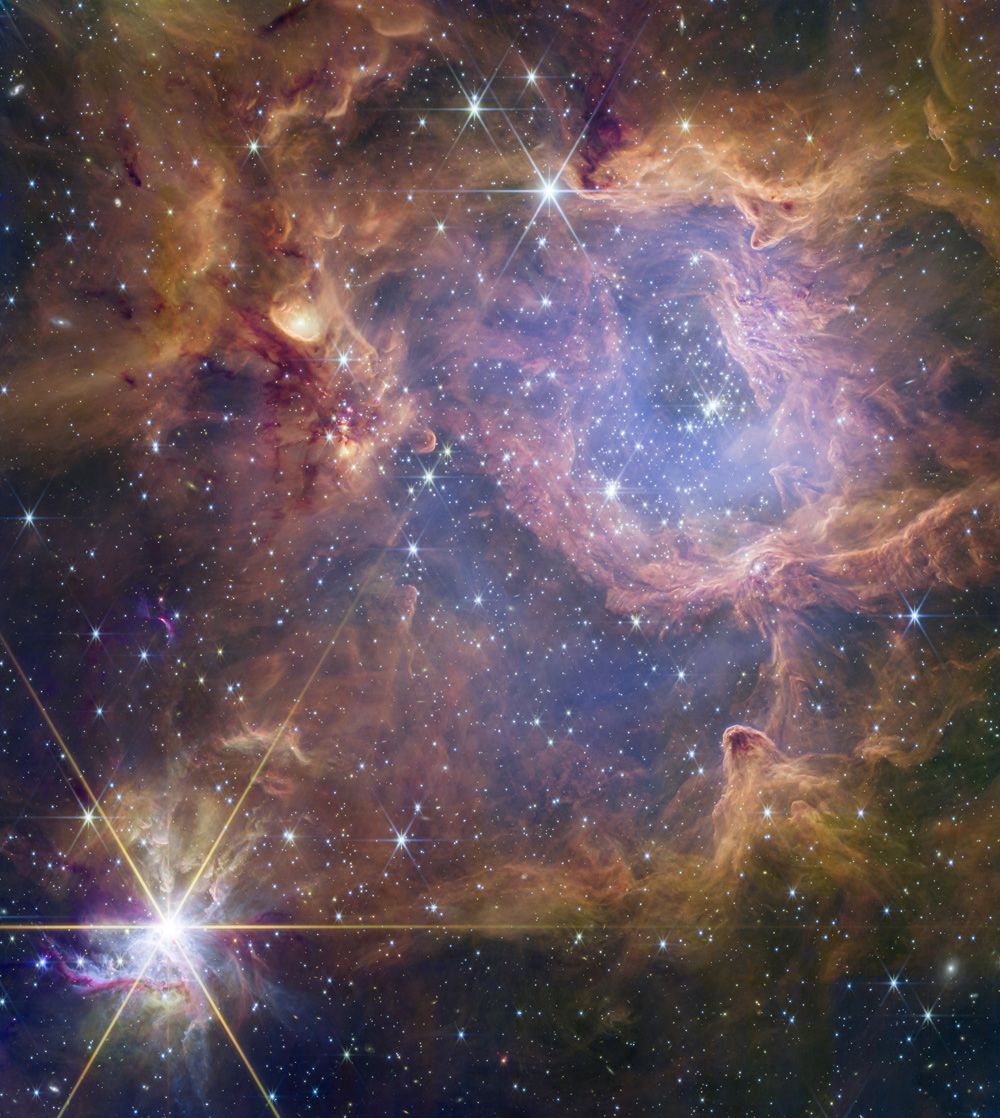
Sharpless 2-305 in the infrared. Credit: Mark McCaughrean (MPIA) / NASA, ESA, CSA / CC BY-SA 4.0
HOLY WOW.
[Click here to get the much larger 6,100 x 6,800 version, because yes you want it.]
This image was taken using JWST by astronomer Mark J. McCaughrean; he and I have been chatting about some of his JWST observations for a while now (and I have another one for you I’ll write up soon because yegads it’s also incredible). He sent me this image just so I can show it to you here on the BAN.
It uses three JWST filters: what’s displayed as blue is actually the 1.82 micron filter (which sees redder stars, as well as water and methane gas), green is the 3.0 micron filter (water ice, typically), and red is 3.6 microns (which sees cosmic dust in the form of long sooty chains of carbon molecules). Mind you, this is all in infrared which we cannot see with our eyes, but the individual images have been displayed using these colors so we can see and interpret them. The reddest light the eye can see is about 0.75 microns, for comparison.
The star cluster is obvious, sitting to the upper right of center (note: the six “crosshairs” you can see in bright stars are called diffraction spikes; they’re due to optical effects inside the telescope and aren’t real). The light from the most powerful stars in the cluster has carved a huge cavity in the gas, creating a thick shell of material around them — the blue fog permeating the inside of the nebula is gas zapped by light from the big stars. The inside edge of the bubble has thick “fingers” of material pointing to the center; these are where the gas and dust is thicker and harder to erode, like sandbars in a stream. What’s left are those fingers pointing toward the most luminous stars (you can see there are two of them very close together just to the right of center).
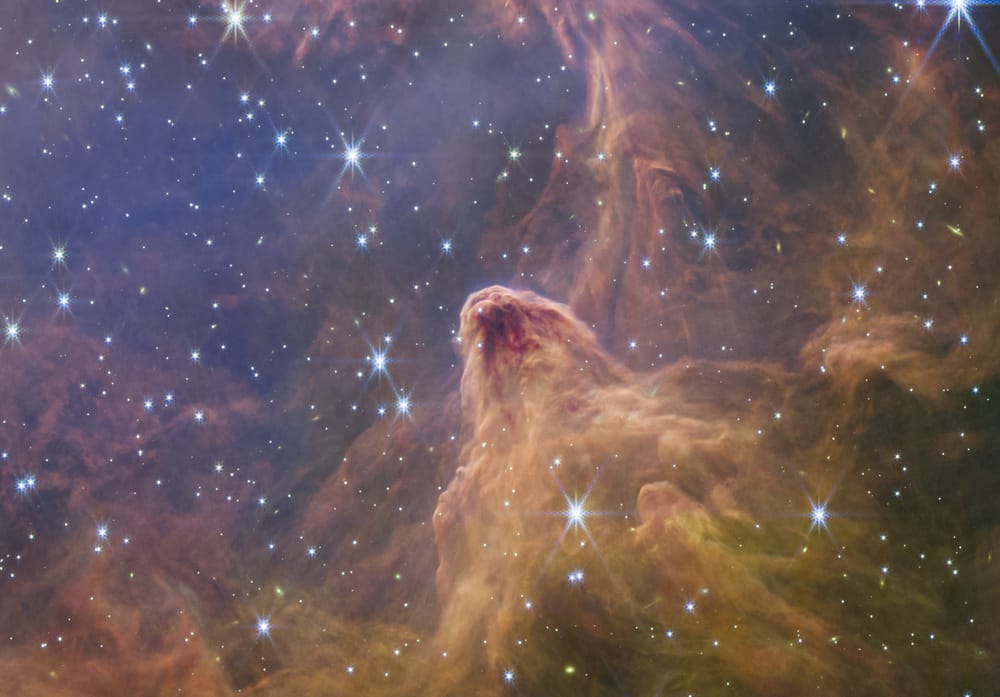
Detail on the finger to the lower right of center. Credit: Mark McCaughrean (MPIA) / NASA, ESA, CSA / CC BY-SA 4.0
I’ll note the nebula looks very different in visible light, the kind we see. This Very Large Telescope (VLT) image, for example, really highlights hydrogen gas in visible light (the kind we see with our eyes), and it almost looks like a different nebula. The little glowing upside-down red-rimmed V structure to the lower right in the VLT image is the same as the tower in the lower right of the JWST image, if that helps. The cavity isn’t nearly as obvious, either, but if you look carefully you can see the same stars in both images in places. That’s not easy, either, because some stars are bright in infrared but dim in visible light, and vice-versa. IDing them can be a chore.
The texture and detail in the JWST image are just spectacular. Infrared light can generally pass through denser dust than visible light can, so dark regions in the nebula are really dense knots of material. These tend to be where new stars are being born; the material is dense enough to collapse under its own gravity to form stars.
In fact, take a look at the lower left corner. That intensely bright star isn’t actually a star, at least not yet: it’s a protostar, caught in the act of forming. Called RAFGL 5232 (among many other names derived from different catalogs), it’s already massive, with about 11 times the mass of the sun! It’s blasting out light at a rate 13,000 times that of the sun, too, which is why it’s booming out in the JWST image. Weirdly, though, it’s far fainter in visible light, since the dense junk around it absorbs most of that light (it’s just barely in the VLT image at the lower left, but is so much fainter it’s not obvious at all).
Here’s a close-up of that fetal star:
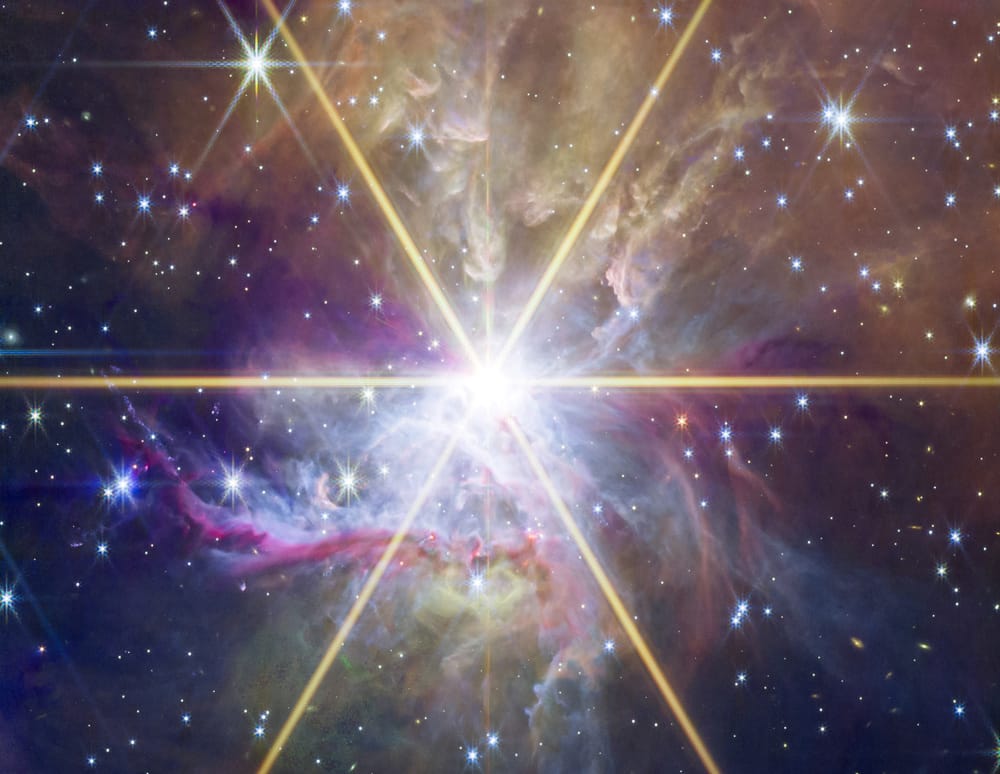
The protostar RAFGL 5232. Credit: Mark McCaughrean (MPIA) / NASA, ESA, CSA / CC BY-SA 4.0
Look at all that material being affected by the almost-star’s light! I love the multi-colored ribbon below it. Spectacular.
This shows the power of using JWTS combined with other telescopes like Hubble or VLT or Chandra: you see different structures in different wavelengths of light, and wholly different objects are revealed. We also get an idea of what’s inside these structures, what elements and molecules are strewn about. That’s always important, and in this case tells us a lot about the environment in which all these stars are forming.
In fact that’s why these images were taken, to examine the range of stellar masses of the newborn stars to see how many low-mass ones are forming compared to higher masses, what’s called the stellar mass function (I wrote about this sort of thing here on the BAN as well as in Scientific American). That’s a critical component to understanding how stars are born.
And that’s important. Our planet happily orbits just such a star, and we’re learning more about it all the time (like, it was almost certainly born in a huge cluster not too different from Sharpless 2-305).
I for one like to understand the neighborhood I live in. It’s just that astronomers have a much bigger definition for that than most folks do.
Et alia
You can email me at [email protected] (though replies can take a while), and all my social media outlets are gathered together at about.me. Also, if you don’t already, please subscribe to this newsletter! And feel free to tell a friend or nine, too. Thanks!
Reply