- Bad Astronomy Newsletter
- Posts
- Hubble unscrambles the Egg Nebula
Hubble unscrambles the Egg Nebula
An amazing image of a dying star fried my brain

Philip Plait
February 16, 2026

The Trifid Nebula and environs. Credit: RubinObs/NOIRLab/SLAC/NSF/DOE/AURA
February 16, 2026 Issue #998
Cracking the shell of the Egg Nebula
New Hubble image shows surprises in a dying star’s paroxysms
The Egg Nebula is an interesting object indeed. Located about 1,000 light-years from us, it’s a pre-planetary nebula, a star that has just begun dying and expelling gas outwards into space, but before the hot core of the star is exposed and a fast wind generated slams into and reshapes the slower moving material. This stage of a star’s death doesn’t last long, just a few millennia, so it’s rare to see one at all, let alone have such a good view.
I studied planetary nebulae for some years, and when I saw this image for the first time a lot of it made sense to me, but I’ll admit, not all of it.
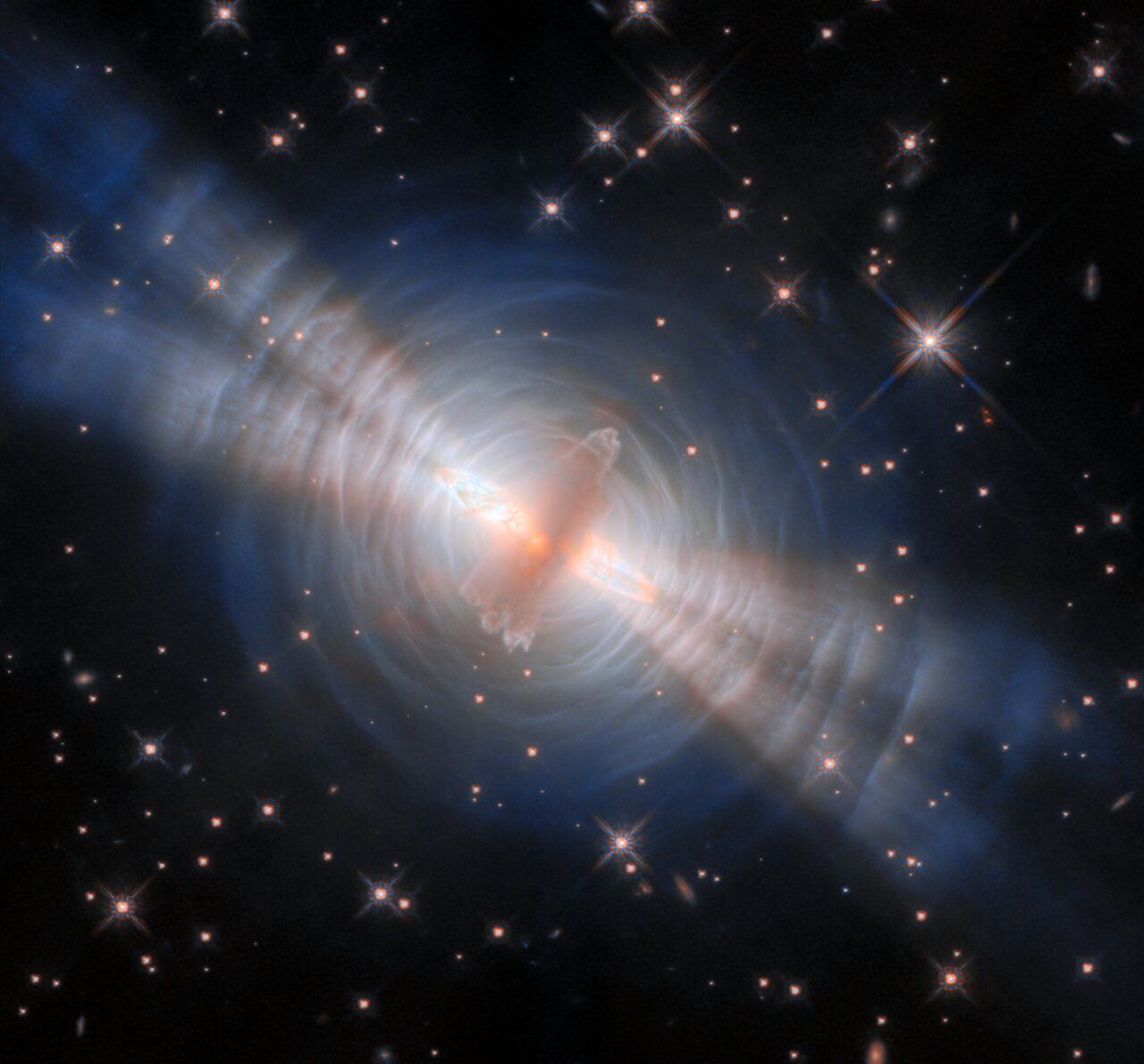
Yeah, there’s a lot going on here. Credit:
ESA/Hubble & NASA, B. Balick (University of Washington)
The whole structure in the image is roughly half a light-year across — most fully formed planetary nebulae (like the Ring Nebula, NGC 6302, and the Helix Nebula) are much bigger than this, so that’s more evidence this thing is just getting its start [click here for a larger version of this image].
That is so cool! But what the heck is it doing?
The star in question is in the center, but not visible in this Hubble Space Telescope image because it’s buried in opaque dust (grains of rocky and sooty material) it expelled some time earlier. That’s typical of dying stars; for example Betelgeuse is known to produce huge clouds of dust it blows out into space, which is what caused it to dim so much in 2019-20. The weird roughly elliptical dark cloud around the star in the center of the nebula (stretching from the lower left to the upper right of the center) is likely dust from that time. That disk strongly hints that the star is actually a binary, two stars orbiting each other. The centrifugal force from their motion throws material out preferentially in the plane of the orbit, forming that flattened disk.
The star itself is very luminous, blasting out 5,500 times as much light as the Sun does [link to journal paper]. It’s hot and very large, 50 times the Sun’s diameter! So it’s still a giant, but not a red one (which have lower temperatures), and is in transition from a giant to a white dwarf — when complete (after the star ejects all its outer layers) it will be much hotter but so small, about the size of Earth, that it won’t be nearly as luminous. But that time is yet to come.
The business side of healthcare

If your healthcare news feels scattered, that’s because it probably is.
Healthcare Brew pulls it together—covering pharma, policy, health tech, and hospital operations in a free newsletter built for the business side of healthcare.
Clear context. Industry interviews. Engaging reporting. Read by 135,000+ professionals who want to know what matters without digging for it.
The concentric circles are actually spherical shells of gas ejected episodically every century or so from the star over the past 4,000 years. The interior of the star is unstable at this stage, and can cause big eruptions of energy that blow off material at a high rate. The shells look like circles because they’re thin, so we only see their edges, similar to why a soap bubble looks like a circle. When we look through the middle there isn’t as much gas along our line of sight as there is near the edge, so the center looks fainter and the edge brighter:

More gas is seen near the edge than through the center. Since the gas is what glows, the edges are brighter than the middle. Credit: Phil Plait
Perpendicular to the dust disk and about the same size are a pair of lobes, one extending away from the center in each direction (to the upper left and lower right). These are young, new structures! Given their size and how rapidly they’re expanding, they likely started off about 250 years ago. The direction is important: Material blown off the dying star gets stopped by the thick dusty disk, so it can only expand away perpendicular to it.
All that I understood right away when I saw the image, since I’ve seen it before. What baffled me, though, were those twin pairs of “searchlights” emanating away from the center, forming the brighter, narrow X-shape. What could cause those?
My first thought was that they’re material expelled by the star, like the central lobes. Sometimes stars like this precess, which means their spin axis rotates around like a dying top. If it blew out material for a while, then stopped for a time, then started up again, you’d get two beams similar to this.
But that doesn’t make a lot of sense physically. The beams are very long, so they’d have to be old, and they just don’t look like ejected material. They look more like light from the star is illuminating the previously ejected shells. But why are there two sets of them?
The astronomers who took these images (including my old friend Bruce Balick) speculate that what we’re seeing is one big cone of light coming from the star (like the beams from a lighthouse), but it’s split down the middle by something casting a shadow. Ah, that makes sense! It’s like if you taped a dime on a flashlight; the beam would expand like a cone away but be darker in the middle.
So what’s casting the shadow? It could be something in the disk, but whatever it is has to be both above and below the disk, to cast a shadow on both beams. So the authors guess it may be the lobes perpendicular to the disk. If you look carefully you can see the lobes are right in the middle of the shadow, so it makes sense they’re the culprits.

A better look at the central region. Credit:
ESA/Hubble & NASA, B. Balick (University of Washington)
In this view you can better see the lobes, and how they may be casting that shadow. What’s shown in red here is molecular hydrogen, which is thicker at the lobes’ tips. That might be responsible for the shadowing.
That’s so very cool. Shadows! Also, I love how, farther out from where the concentric rings are visible, the searchlights are still illuminating some of the gas, so we see a series of nested arcs instead of whole circles. There are obviously a lot more of those shells than you can easily see here. In fact, unlike in a planetary nebula, where the gas is zapped by ultraviolet light from the central white dwarf and glows on its own, almost all the material you see in this image is from the central star’s reflected light. It’s a big ol’ light bulb in the middle of all this stuff, lighting it up.
Sometime in the near future, probably in the next few thousand years, the star will have blown off all its outer layers, the searingly hot core of the star will be exposed, and the Egg will become a proper planetary nebula. Until then, though, it’s still in the process of getting there. I wonder what changes future astronomers will see in this enormous and spectacular cloud of gas in the coming centuries?
Et alia
You can email me at [email protected] (though replies can take a while), and all my social media outlets are gathered together at about.me. Also, if you don’t already, please subscribe to this newsletter! And feel free to tell a friend or nine, too. Thanks!
Reply